

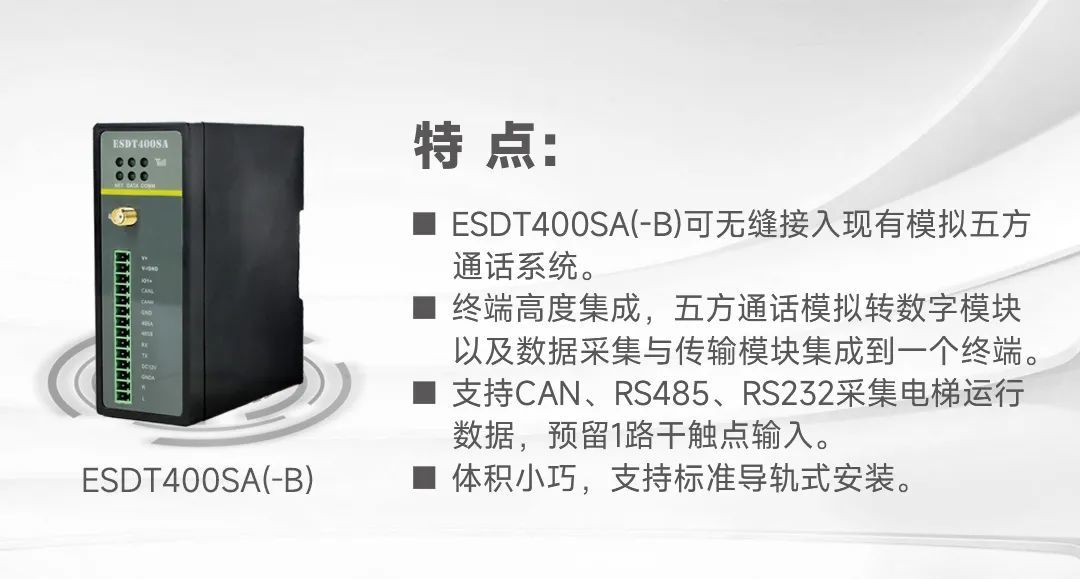
STEP has launched the ESDT400SA(-B) terminal, which combines data collection with voice calls, expanding the hardware lineup of the Elevator Cloud family. (Click to view previous report) The terminal has since received widespread acclaim from both conventional elevator users and villa elevator clients, successfully helping numerous customers pass the acceptance inspection conducted by the Hangzhou local government’s regulatory platform. It provides a powerful tool for intelligent elevator supervision, on-demand maintenance, and emergency rescue operations.
Recently, STEP announced that, building on its existing features, the terminal now offers two new services: a call-back function and a wiring-free solution connecting the duty room to the machine room. Meanwhile, a GBT24475 elevator remote alarm system—based on existing analog walkie-talkies—will also soon become a reality.
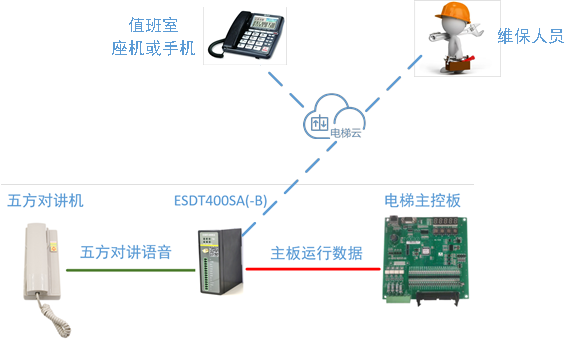
1. System Architecture Diagram
II. New Features of ESDT400SA(-B)
√ Added a callback function. The call-back function allows maintenance personnel, if they fail to answer an incoming call, to dial the caller’s displayed number to initiate a call-back. During the callback, the prompt tone will indicate the extension number; press the # key to confirm. At this point, the maintenance personnel’s mobile phone can automatically dial back to the elevator, re-establishing the call.
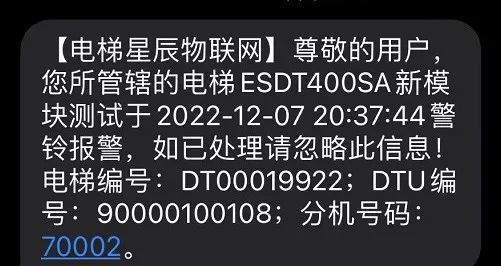
Extension number notification method: SMS alert. After the trapped passengers in the elevator car press the alarm bell to raise an alert, an SMS message will be sent to the maintenance personnel. The SMS message will include the elevator name, elevator number, DTU number, and extension number. The principle for sending these SMS messages is to use the maintenance personnel’s phone number that was pre-registered during network access. An example of the SMS message is shown in the figure below:
√ Can provide a solution for eliminating the cabling between the equipment room and the duty room. This terminal establishes communication between the equipment room and the duty room. The duty room can be equipped with either a standard landline phone or a mobile phone. For this type of application, the first number set by the user can be either the duty room’s standard landline phone or a mobile phone number. If the duty room cannot be reached, the call will automatically forward to the second or third maintenance personnel’s mobile phone number.
√ Optimize the call server The cost of IP calls has been upgraded from being included for 3 years to having no time limit, further reducing usage costs.
√ Meets the requirements based on existing analog walkie-talkies and this terminal.
Technical Requirements for the GBT24475 Remote Alarm Device System The feature will be launched soon—stay tuned!
3. Basic Voice Call Functionality
√ Works in conjunction with a four-wire analog intercom system to enable communication between cabin personnel and remote maintenance staff via mobile phones or desk phones in the duty room. The SIM card does not need to have call functionality activated; communication is realized via VoIP.
√ You can remotely set up to 3 phone numbers (mobile or landline) via the cloud platform, eliminating the need for on-site configuration.
√ After the cabin personnel press the cabin call button, the system can sequentially dial the set phone numbers until one of them is connected.
√ The terminal can parse alarm signals (ringing signals) from the five-party system and upload them to the platform, where they will trigger a pop-up notification on the platform.
√ When a person is trapped or an elevator malfunction occurs, the terminal can play a soothing voice message to the car’s auxiliary unit via the five-party intercom interface.
√ After the passenger presses the alarm button, the terminal control unit activates the auxiliary device in the elevator car to play a pre-recorded voice prompt confirming the alarm signal.
√ A car-mounted machine, paired with this terminal, can also enable remote calls. For villa elevator applications, there’s no need to add an additional machine room host.
4. Data Acquisition and Transmission Function
√ Collection and transmission of elevator operation data (including status, faults, events, statistical information, alarm bells, etc.).
√ Supports remote upgrade service.
√ Supports elevator call via mobile app or WeChat mini-program.
5. Terminal Selection
√ ESDT400SA, comes with a built-in SIM card, including 3 years of data traffic and unlimited IP calling fees.
√ ESDT400SA-B, SIM card not included; customers can provide their own. Includes unlimited IP calling fees.
Scan the code to download the STEP Elevator Cloud App.
