
STEP Servo | Making Parallel Robots More Stable, Faster, and Stronger
2020-10-16

1. Equipment Introduction
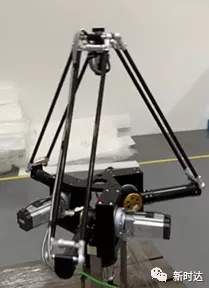
A typical parallel robot, such as the four-axis machine shown in the figure above, is capable of translational motion along the three spatial axes—X, Y, and Z—and rotational motion about the Z-axis. Its mechanical structure consists of a motor connected via a gearbox directly to the main arm. The main arm is linked to a secondary arm through limiters. A fourth axis, located either on a fixed platform or a moving platform, enables rotation about the Z-axis. During operation, the motor drives the main arm to swing up and down within a specified angular range, thereby precisely positioning the moving platform via the secondary arm.
2. Proposal Introduction
The Ωm-N1 series servo drives used in this solution are multi-axis products launched by the Motion Control Division of STEP. The system employs EtherCAT bus communication. Featuring a DC bus power architecture, these drives support cascaded power supply for multiple drive units and offer flexible customization options for both three-axis and four-axis integrated solutions, thereby meeting the needs of various application scenarios.

3. Product Configuration
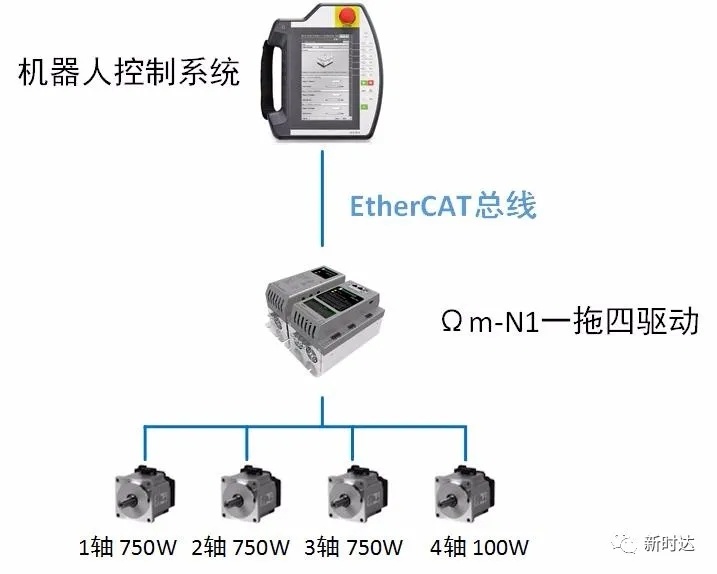
The main configuration of this solution is shown in the diagram above. The robot control system is connected to the Ωm-N1 drives via an EtherCAT bus. Each drive is equipped with axes 1, 2, 3, and 4 of a Delta robot. The one-click rigidity adjustment function enables simple and rapid tuning of system responsiveness, significantly reducing customers’ debugging time. Thanks to the drive’s 3-times overload capacity and hardware current-loop response, the system can achieve a cycle rate of up to 150 cycles per minute under standard gate-shaped motion tests. The outstanding end-effector vibration suppression feature effectively eliminates end-effector vibrations below 100 Hz, ensuring fast response while preventing any jitter at the end effector from compromising the final gripping performance.
4. Program Features
(1) The ODM adopts the standard 402 protocol, which is compatible with mainstream control systems available on the market, including Keba’s robot control system.
(2) The Ωm-N1 four-axis integrated drive, with one controller driving four axes, perfectly matches the configuration of parallel robots and delivers high synchronization performance.
(3) Compact enough to fit comfortably in one hand, it helps customers save space in electrical cabinets. With the option of bracket mounting, installation space can be further minimized, fully meeting customers’ customized requirements.
(4) By leveraging the dynamic braking function, we can prevent uncontrolled vehicle collisions caused by abnormal commands or movements.
(5) The motor with self-identification matching eliminates the hassle of customer debugging—customers only need to set one rigid parameter to meet their various response requirements, significantly reducing the time required for adjustment and tuning.

Contact Us
Email:
market@stepelectric.com
Address:
No. 1560, Siyi Road, Jiading District, Shanghai Municipality