
Keep the momentum going | Zhongweixing accelerates mask production with a “fast-forward” button.
2020-03-30

[STEP Group | Zhongweixing] Today, while China has emerged from the darkest days of the pandemic, the epidemic situation overseas is becoming increasingly severe. With medical supplies being heavily consumed, demand for mask-making machines in the market remains consistently strong.
By pulling strings and relying on connections, I managed to get hold of a mask-making machine—or alternatively, I could’ve spent ten yuan on Taobao to buy a set of blueprints and develop the machine myself by following those instructions. But in the end, I realized that what really defeated me wasn’t the price, but rather the equipment’s debugging process.
As the saying goes, “30% is about manufacturing, 70% is about adjustment.” Given that mask-making machinery has long production lines and numerous components, and since masks themselves are made of flexible materials with poor stability, after the equipment is assembled, many technical parameters need to be fine-tuned to reach their optimal settings. This adjustment directly affects key performance indicators such as machine failure rates and yield rates.
The entire commissioning process relies heavily on the engineer’s experience. If coupled with more efficient PLC programming and a user-friendly HMI interface, commissioning efficiency can also be improved.
For example
·PLC programming employs function block calls, providing clear real-time status visualization and making it easier to pinpoint problem areas.
·The screen layout of the human-machine interface is divided into blocks, facilitating centralized debugging of device area functions.
Recently, Zhongweixing successfully passed customer acceptance testing for its fully automatic “one-to-two” flat-mask machine control solution, which is centered around the AMC1600E bus-based controller.
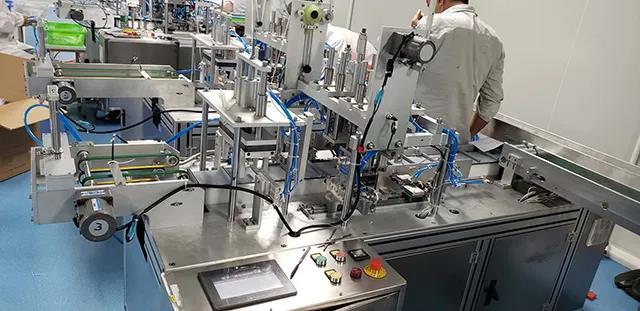
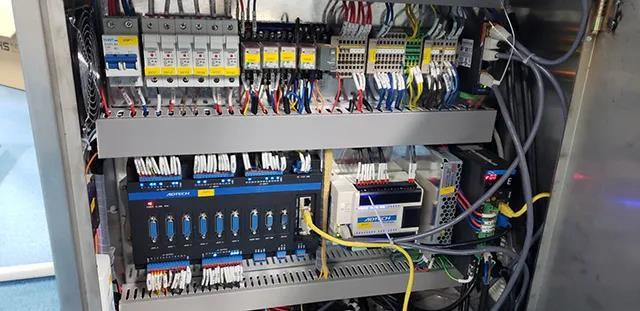
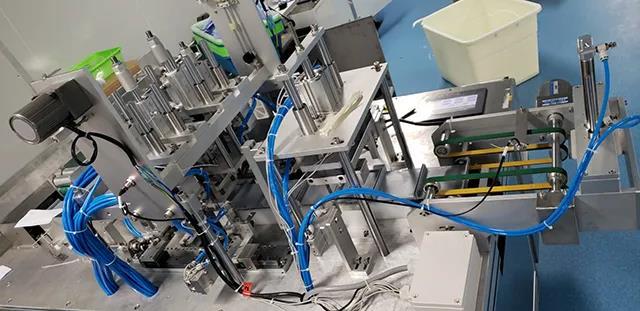
On-site commissioning of the customer’s mask production line.
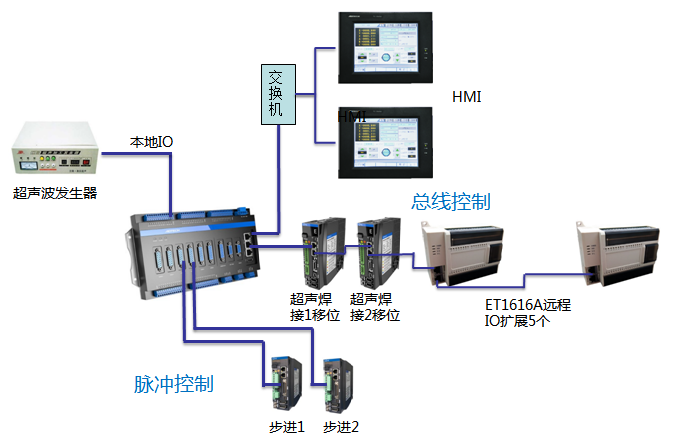
This solution employs bus-based control, which not only enhances the response speed and increases control precision but also facilitates the easy expansion of external I/O devices. The PLCOpen motion control command library effortlessly meets various motion requirements in mask production. Programming is carried out using IEC61131-3 standard languages (IL, FBD, SFC, ST, LD), fully leveraging the flexibility of the ST language. Complex and intricate motions are broken down into functional blocks, making runtime calls simpler and more straightforward.
Equipment Introduction

Equipment Configuration (Click to view larger image)
This solution is suitable for the fully automated production of flat-face masks and primarily includes processes such as coil material feeding, folding and assembly, nose-bridge strip feeding, mask shaping, mask cutting, earloop feeding and welding, and finished-product discharge. The equipment can also be viewed as comprising three main components: sheet forming, sheet separation, and welding. The equipment is capable of completing the entire production process—from raw coil materials all the way to finished masks—producing masks that are comfortable to wear and free from any feeling of pressure. Additionally, depending on user requirements, the flipping and sheet-separation motors can be replaced with pneumatic cylinder actuators, which helps reduce the number of motors used.
Electrical Components List

*The above lists only a portion provided by Zhongweixing.
Electrical System Configuration
PLC Program Introduction
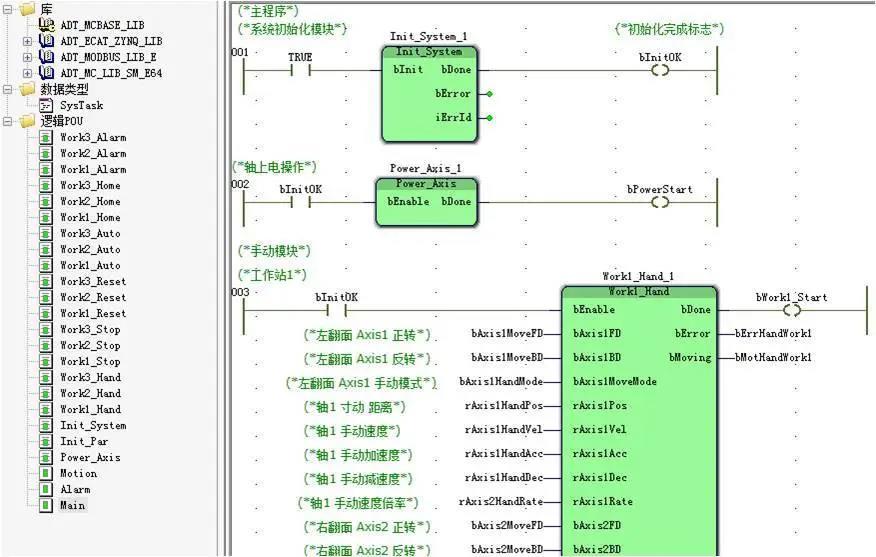
The program is mainly divided into three major parts: the main program, alarm functions, and automatic operation.
By using the ST language, numerous complex actions are integrated into FBD function blocks according to the equipment workstations. These function blocks are centrally called from three main programs, which not only facilitates the rational division of easy and difficult tasks during programming but also ensures that, during equipment debugging, unnecessary variables are kept to a minimum, thereby enhancing program readability. Finally, a multitasking mechanism is employed to enable smooth execution of the main program.
HMI Human-Machine Interface
The HMI human-machine interface is divided into pages for automatic mode, manual mode, parameters, functions, and alarms.
Automatic interface: It primarily includes real-time display of axis positions, device production count statistics, and operational functions such as start, stop, reset, zeroing, pause, and clear for different workstations.
Manual operation interface: First, there are separate manual interfaces for different workstations. Then, within the status interfaces for each workstation, there are additional pages for manual motor operation, manual cylinder operation, and sensor monitoring.
Parameter page: Divide the interface according to different workstations, and set the corresponding manual, automatic, and zero-return parameters under each interface.
Alarm interface: Includes real-time alarm and historical alarm interfaces. Alarm information includes the date, time, and specific occurrence time. Historical alarms can be queried for alarm records within the past week.
Next, let’s watch a video demonstration to get a feel for the HMI human-machine interface’s operation流程 →

Contact Us
Email:
market@stepelectric.com
Address:
No. 1560, Siyi Road, Jiading District, Shanghai Municipality