
Breakthrough | STEP Palletizing Robot Achieves a Cycle Rate of 1,000 Packages per Hour
2020-03-30

Recently, the high-quality robotics brand STEP Robotics announced a new breakthrough in its technology research and development: its flagship palletizing robot models SP120/2400 have achieved a cycle time of 1,000 packages per hour in real-world operating conditions. With performance that outpaces domestic brands, these robots are the first to challenge leading international brands.
Following the strategic goal of "benchmarking against imports and ultimately replacing them," STEP Robotics has focused on product R&D, striving for excellence in multiple areas—including algorithms, software, mechanics, and electrical systems. As a result, the production rate has been increased from the original 720 packages per hour to 1,000 packages per hour. The breakthroughs achieved in this technological advancement will be incorporated into STEP Robotics’ entire product line, further enhancing the quality of its robots and helping partners and users boost their operational efficiency. This will also free workers from harsh environments, physically demanding tasks, and monotonous, repetitive work.
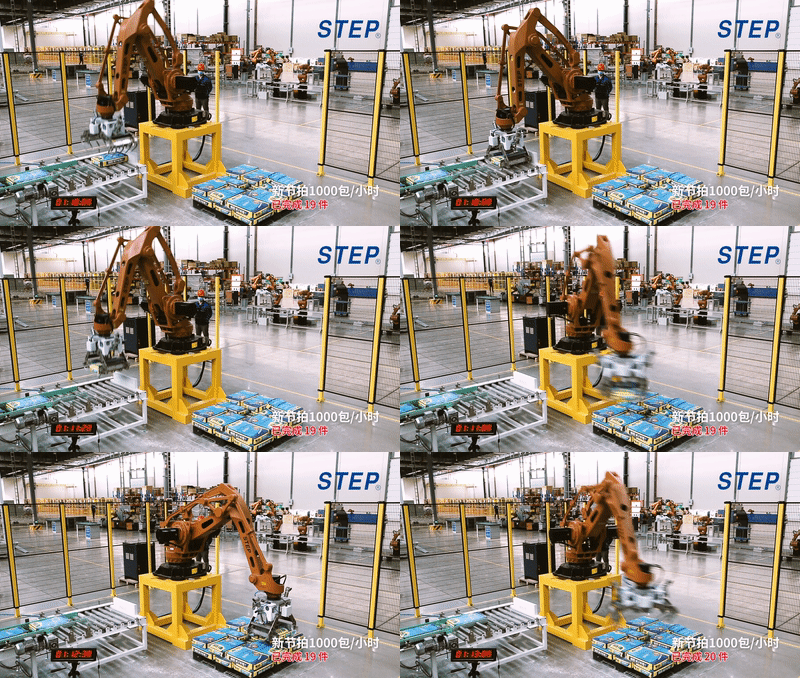
Due to operational requirements, the key performance indicator for palletizing robots is cycle time. The cycle time of top-tier international brands of palletizing robots typically ranges around 1,100 to 1,200 packages per hour. Domestic robot brands, having started later and constrained by their technological capabilities, generally have cycle times below 700 packages per hour, creating a significant gap compared to leading international brands. The recent achievement by STEP Robotics—breaking the 1,000 packages per hour mark in palletizing robot cycle time—is highly significant. Moving forward, STEP Robotics will continue to push the boundaries, aiming to reach cycle times of 1,100 and even 1,200 packages per hour, thereby attaining the same quality standards as those of the world’s leading brands.
The demand for palletizing robots in the market is on a steady upward trend. The shortage of labor is particularly pronounced at palletizing workstations—commonly referred to as "carrying heavy packages." Due to the high intensity and arduous nature of palletizing jobs, especially during the hot summer months when workers have to handle and stack several tons of products each day, only physically strong and robust laborers can endure such conditions. From an employment age perspective, the hardworking generations born in the 1960s and 1970s are gradually retiring from the high-intensity labor market, while the younger generations born in the 1980s and 1990s show little willingness to take on such physically demanding jobs that lack technical content. As a result, recruiting palletizers has become increasingly difficult. According to statistics from the International Federation of Robotics (IFR), in 2018, China's market saw 154,000 new robot installations, with over 60,000 of these being newly added material-handling and loading/unloading robots—a category that represents the largest application segment in China's robotics market. Palletizing robots are increasingly being adopted in industries closely tied to national economic stability and people's livelihoods, such as rice, animal feed, beverages, table salt, and fertilizers—sectors characterized by high product demand.

Contact Us
Email:
market@stepelectric.com
Address:
No. 1560, Siyi Road, Jiading District, Shanghai Municipality