
ADT-89C9 C1/H1 High-performance 12-axis pulse motion control card based on the PCI bus

- Product Description
- Specification Parameters
- Download Materials
-
- Commodity name: ADT-89C9 C1/H1 High-performance 12-axis pulse motion control card based on the PCI bus
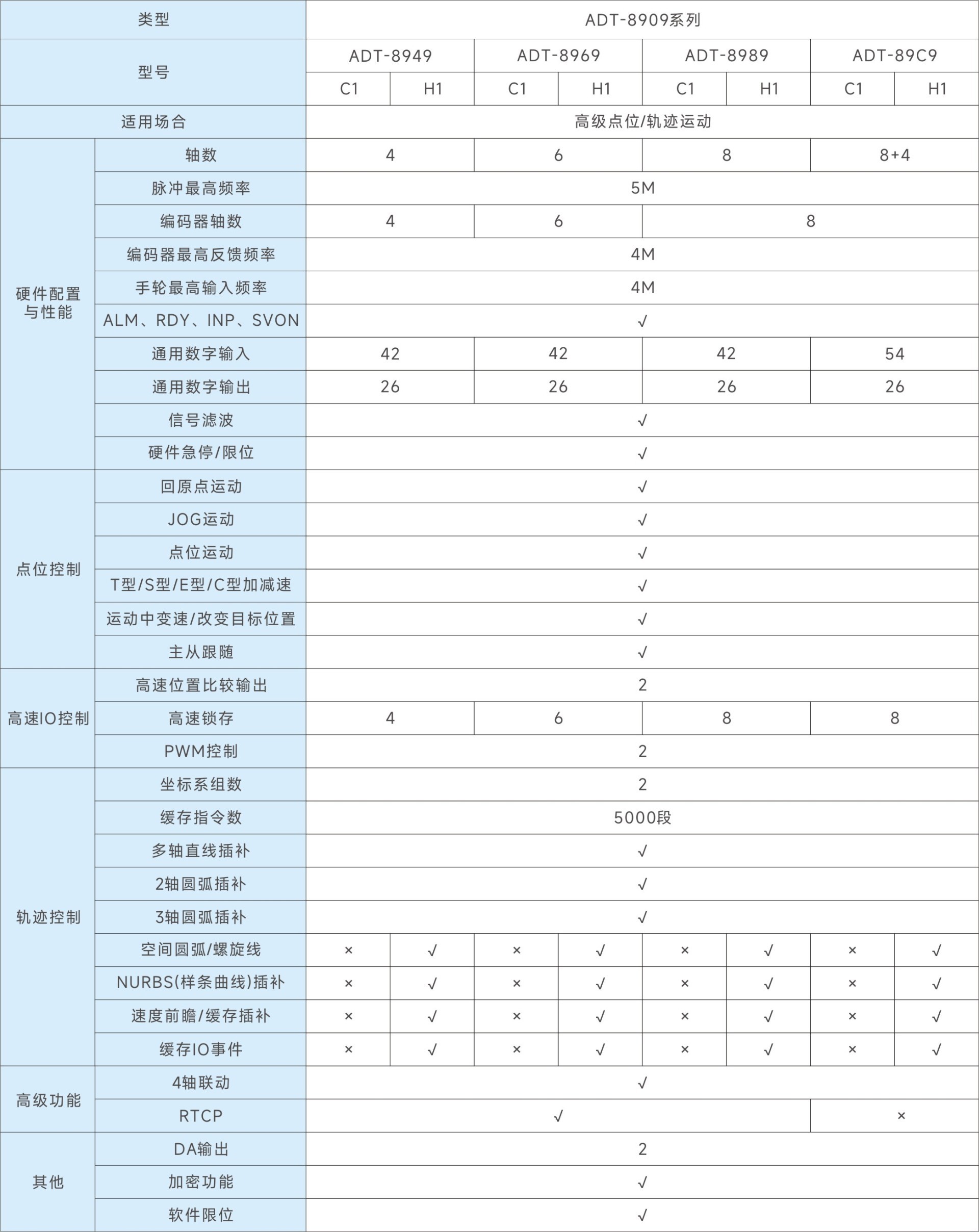
The ADT-89C9 C1/H1 is a high-performance pulse motion control card that supports up to 12 axes (8 servo channels and 4 stepper channels). It features 54 input channels, 26 output channels, one RS485 interface, and includes position cards and trajectory cards.
Product Introduction
• The ADT-8909 series motion control card is a high-performance, multi-axis (4/6/8/12) motion control card developed by Zhongweixing, based on the PCI bus and a dual-core platform.
• The ADT-8909 series motion control cards continue to leverage the company’s longstanding commitment to high-precision technology. Compared with other similar products, these cards boast exceptionally superior hardware performance specifications: a receiving frequency as high as 8 Mpps, a high-speed PCI bus running at 33.3 M, a greater number of configurable extended I/O ports and interruptible I/O ports, support for hardware serial codes, capability for third-party encryption functions, and a high-speed pulse frequency output of up to 5 Mbps.
• The small-line segments and large buffer of the ADT-8909 series high-performance motion control card are specifically designed for engraving or cutting applications, enabling the data generated after CAM discretization to be accurately reconstructed into the machining model. Moreover, its 3D arc interpolation (spherical interpolation) can generate arcs in any spatial plane as well as spherical arcs, making it ideal for simplifying the teaching operations involved in complex graphics.
• Thanks to the use of 33.3M PCI communication, up to 10 control cards can be expanded on a single PC. Moreover, leveraging the PC platform allows for complex applications such as distributed motion control.
• The ADT-8909 series PCI-based pulse motion control card is suitable for a wide range of control applications, including engraving, cutting, turning, milling, punching, and drilling. It features a 5 Mpps pulse control mode and AB-phase decoding, making it applicable to both stepper open-loop control and servo closed-loop control. A speed-adaptive model is employed in high-precision control applications such as milling machines and tool grinding, enabling the motor to operate within a reasonable error margin through sophisticated velocity planning.
Features and Advantages
• Asymmetric acceleration and deceleration operation is smooth, and the motor is very quiet. Asymmetric acceleration and deceleration planning can be employed to ensure extremely smooth motor operation, thereby reducing noise and making it suitable for industrial environments with stringent noise requirements.
• Hardware-level interpolation supports spatial curve interpolation. Hardware interpolation technology is integrated into spatial curve interpolation, enabling rapid calculation of T/S/E/COS-type acceleration and deceleration curves based on the set acceleration and deceleration profile.
• The adaptive speed model ensures high precision at high speeds. The adaptive speed model ensures both high speed and high precision, meeting the demands of high accuracy and high efficiency in industrial applications.
• Hardware can be upgraded—not just for now, but also for the future. The multi-embedded system featuring an FPGA plus dual DSP ensures critical performance through hardware-level real-time processing. Moreover, hardware upgrades enable the control card to maintain backward compatibility, meaning that new products are fully compatible with older versions, thereby delivering maximum value to customers.
-
Keywords:
ADT-89C9 C1/H1 High-performance 12-axis pulse motion control card based on the PCI bus
Product Category
Content update in progress,...