
[People's Daily Online Report] STEP Robot: Driven by Innovation, Seizing the New Frontier of the Digital Economy
2022-11-29
![[People's Daily Online Report] STEP Robot: Driven by Innovation, Seizing the New Frontier of the Digital Economy](https://omo-oss-image.thefastimg.com/portal-saas/pg2025033114062148196/cms/image/89378a99-8482-43a9-acea-8885be6803b9.jpg "[People's Daily Online Report] STEP Robot: Driven by Innovation, Seizing the New Frontier of the Digital Economy")
In the sprawling factory spanning 20,000 square meters, robots operate with pinpoint precision along the production line, and workers are virtually invisible. “Robots making robots”—this scene is already a reality at the Shanghai STEP Robotics Factory, located in Nanxiang Town, Jiading District. This Shanghai-based enterprise, which has been in operation for over 20 years, is one of the companies in Shanghai with the highest density of domestically branded robots. Currently, all four of its factories are in the process of being transformed into digital factories.
Robots are hailed as the “pearl atop the crown of manufacturing” and serve as an important indicator for measuring a country’s level of scientific and technological innovation and high-end manufacturing. According to these figures, one-third of the world’s robots are produced in China, and one-third of China’s robot production takes place in Shanghai. The robotics industry has thus become a new hallmark of “Made in Shanghai.”
Smart factories are the primary battleground for Shanghai’s digital transformation of its manufacturing sector, involving integrated applications such as smart equipment and intelligent robots. Shanghai is promoting the construction of smart factories in a tiered and categorized manner, accelerating its deployment in new tracks of the digital economy.
Shanghai’s first robot-manufacturing, robot-intelligent factory
“Currently, across the entire STEP Group, robot density has reached 1,080 units per 10,000 workers—far exceeding China’s average of 246 units per 10,000 workers and rivaling that of the world’s countries with the highest robot densities,” said Zhang Zhenkui, Director of the President’s Office at Shanghai STEP.
The density of industrial robots reflects the level of automated production in a country or region and serves as an important reference for economic digital transformation.
According to the Shanghai Municipal “14th Five-Year Plan” for the development of the high-end equipment industry, by 2025, the scale of the high-end equipment industry will exceed 650 billion yuan, and key sub-sectors will shift from following and keeping pace with international leaders to taking the lead. In the field of intelligent robotics, Shanghai will focus its efforts on three key areas: upgrading industrial robots, expanding the scale of service (special-purpose) robots, and achieving breakthroughs in core robotic components. This year marks the concluding year of the “Special Action Plan for Building More Than 100 Smart Factories (2020-2022).” The plan aims to build 100 smart factories over a three-year period and establish 10 benchmark smart factories.
“Currently, the STEP Robotics Superfactory boasts a 20,000-square-meter facility but requires only nine workers to oversee production lines and perform certain operations that still need human intervention. Meanwhile, tasks such as parts assembly, material handling, precision welding, and sample inspection are all handled by robots,” Zhang Zhenkui explained.
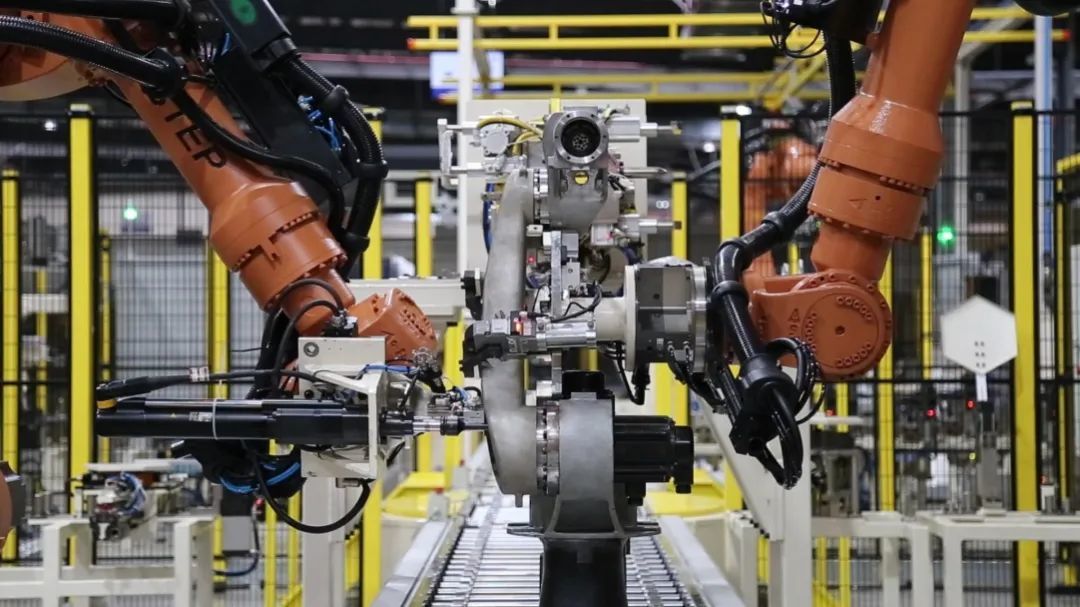
STEP Robotics’ super factory achieves “robots manufacturing robots.”
The factory officially went into operation in December 2020, becoming the first in Shanghai to use robots to manufacture robots. Its annual production capacity has reached 10,000 industrial robots. The factory was subsequently selected as one of the first 20 smart factories in Shanghai and as a pilot demonstration factory for intelligent manufacturing under the Ministry of Industry and Information Technology. By adopting robots on a large scale, the number of workers required has been reduced by 80%, and the first-pass yield of product testing has increased by 15%. Empowered by highly efficient and flexible automation technologies, the factory has achieved a designed annual production capacity of 10,000 units, with a more than 30% increase in output efficiency per unit area compared to previous manual operations.
The construction of smart factories will inject new momentum into Shanghai’s sustained, high-quality industrial growth.
Smart manufacturing helps the manufacturing industry move toward high-quality development.
Fan Zeng, Deputy General Manager of the STEP Robot Division, introduced that the small-load robot automated production line within STEP’s Super Factory is a modern, intelligent manufacturing robot production line that has achieved a robotic-to-robot assembly process. This production line comprehensively takes into account the product structures of three different robot series, breaks down the manufacturing process accordingly, and customizes assembly logistics lines and tooling fixtures. While ensuring high-quality product assembly, it balances the production capacity of each robot on the line, thereby enhancing product quality and reducing manufacturing costs.
“The robots used on the production line are also from the STEP brand, and all of the factory’s smart manufacturing projects have been independently developed and integrated by STEP itself,” Fan Zeng explained.
Workers on the production line may make operational errors. If robots are used to manufacture other robots, could operational errors or technical deviations occur?
Fan Zeng provided the answer: Since the intelligent manufacturing project for STEP robot factory is relatively complex and customized, there are no complete case studies to draw upon. To ensure project quality and on-time delivery, STEP established China’s first CAVE virtual commissioning laboratory during the implementation phase.
Before the project’s implementation and construction began, we leveraged virtual digitalization to create virtual prototypes, enabling rapid reviews, ergonomic analyses, virtual interactive commissioning of production lines, virtual maintenance and maintenance evaluation, as well as interactive product demonstrations. After numerous iterations and validations through virtual digitalization, the project was successfully delivered, ensuring both the technical stability of the production line and continuous improvement in product quality. Since going into production more than three months ago, the qualification rate of robotic products produced on STEP Robotics’ robot assembly line has reached 99.4%.
With a large number of robotic components and long lead times for some parts, the STEP Robotics Factory has adopted intelligent warehousing and logistics technologies to optimize inventory management: it uses automated three-dimensional warehouses to store smaller-sized materials, flat-floor warehouses for bulkier items, a circular sorting warehouse for automated robot sorting, and AGVs for intelligent material handling within the factory premises. “Just as wearing a suit calls for leather shoes and a tie, these supporting, intelligent platforms—essential for boosting robotic manufacturing efficiency—make rational use of space, ensure production capacity, and guarantee timely product delivery,” said Fan Zeng.
This year, under the backdrop of the pandemic, the high-quality manufacturing capabilities of STEPeng Robotics’ super factory have become even more prominent. In a market where foreign brands are experiencing supply shortages and having stock available is itself a competitive advantage, STEPeng Robotics has maintained timely deliveries, helping downstream industries expand their production capacity.
Today, STEP Robotics has driven large-scale applications in industries such as 3C, lithium batteries, photovoltaics, white goods, metal processing, and automotive components. It serves numerous manufacturing enterprises—including domestic “Industry 4.0 lighthouse factories” like Foxconn and Haier. In 2021, STEP became the first Chinese brand to accumulate shipments exceeding 20,000 units, significantly boosting the substitution of imported robots with domestically produced ones and contributing to the refinement of the industrial chain, thereby helping manufacturing move toward high-quality development.
The “Workshop Brain” Enables Intelligent Manufacturing
In the STEP workshop, there’s a miniature simulation scenario like this: In the bustling automotive parts production workshop, an automated production line is running smoothly and efficiently. The planner releases production tasks from the ERP system, and the production supervisor, taking into account constraints such as capacity, assigns the workshop’s operational schedule. But before that happens, the process designer first submits the process management information to the manufacturing department. Then, workshop operators take control of the equipment and begin executing the production tasks. Parts are assembled one by one and sent down the production line. Once production is complete, the relevant data is fed back to the planner.
The entire process is efficient and accurate, and most importantly, it doesn’t involve the dense crowds of personnel typical of traditional workshops. So how exactly is this series of automated production achieved? Fan Zeng explained that the key lies in MES—the most critical component of intelligent manufacturing software.
Fan Zeng explained that, as the “brain” of the workshop, the MES sits between the higher-level planning and management system (ERP) and the lower-level industrial control systems. It provides operators and managers with real-time visibility into the execution and tracking of plans, as well as the current status of all resources—including personnel, equipment, materials, and customer demands.
For a long time, a major pain point in industrial intelligent manufacturing has been the difficulty in seamlessly connecting various links and processes. The eMES system, independently developed by STEP, can prevent various types of faults or other adverse conditions from occurring. It also enables highly coordinated operations among STEP numerous systems and achieves real-time data synchronization across different systems, thereby reducing employees’ workload and alleviating their work intensity.
In addition, the eMES system not only enables information-based readability of workshop production but also facilitates quality inspection and real-time feedback under AI-powered visual detection, making the entire workshop operation more intelligent and effectively mitigating the drawbacks of automation—such as “lack of intelligence” and “mechanization.”
“STEP also pays special attention to energy consumption management and real-time equipment monitoring, thereby reducing equipment operational wear and tear,” said Fan Zeng. All of this operates under a visualized data platform, truly realizing the operation of a “workshop brain” that is controllable and manageable.
Driven by innovation, seize the new frontier of the digital economy.
In 2021, STEP achieved a major technological breakthrough in the critical area of robotics performance enhancement—higher-order dynamics algorithms. By adaptively and accurately predicting changes in robot inertia and payload in real time, the company significantly improved key performance indicators such as operating speed (cycle time), operational stability, positioning accuracy, and noise reduction. As a result, SCARA, arc welding, and palletizing robots have now reached parity with leading international brands.
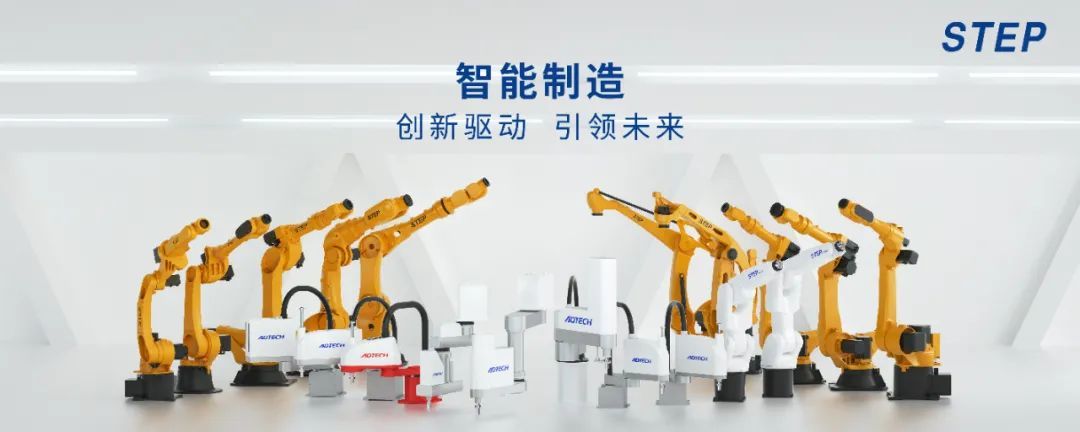
STEP Robotics has developed a complete product lineup.
According to Dr. Jin Xinhai, President of STEP, outstanding talent is the inexhaustible driving force behind STEP continuous innovation and development in the future. “STEP places great importance on talent development and has established an excellent talent cultivation system centered around the STEP Academy. After 27 years of growth, STEP R&D team now comprises nearly a thousand R&D personnel, accounting for 36% of the total workforce. The team has undertaken three national science and technology support program projects, spearheaded or participated in the drafting and revision of 32 national technical standards, and led or contributed to the development of eight industry technical standards. Furthermore, the company has obtained 730 authorized patents, including 242 invention patents and 266 software copyrights.”
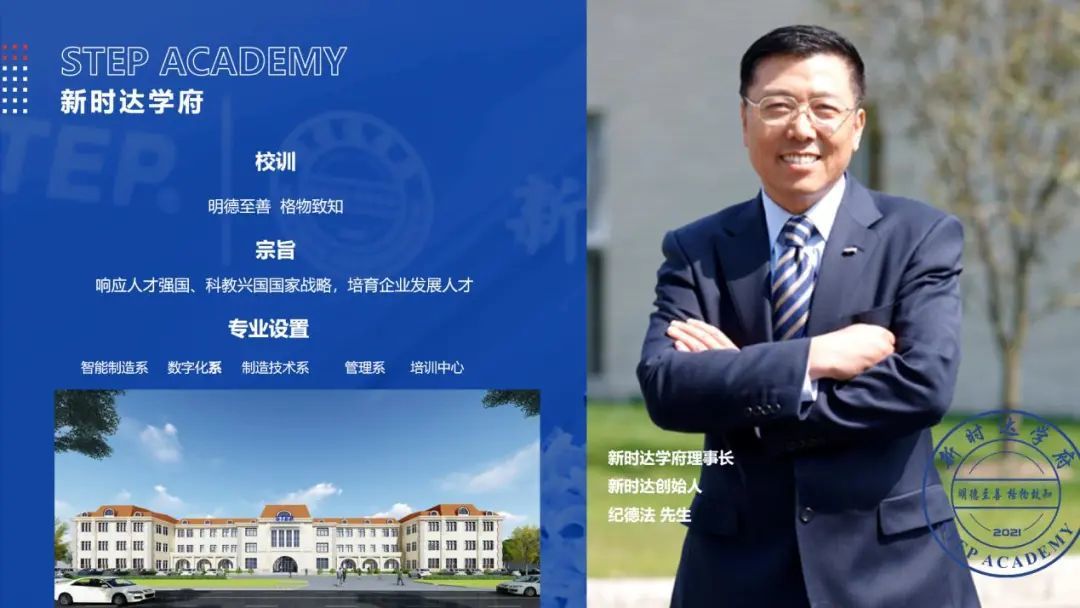
Founded in July 2021, STEP Academy has become an incubator for STEP’s talent.
In Dr. Jin Xinhai’s view, the development of New Era Robotics offers a microcosm of China’s robotics industry. Over the past decade or so, China’s robot sales have surged steadily, significantly boosting manufacturing capabilities and giving humanity the opportunity to share in the convenience and happiness of an intelligent society.
Data shows that Shanghai now accounts for roughly one-ninth of global industrial robot production. International robotics companies have been setting up their China headquarters or regional robotics headquarters here, while leading domestic robotics firms are rapidly expanding their investment and operational presence. Meanwhile, a large number of top-tier enterprises in specialized sub-sectors are experiencing rapid growth, emerging as the new generation of industry drivers and technological innovation hubs.
“In the future, as China’s manufacturing sector accelerates its transformation and upgrade, manufacturers will increasingly demand higher efficiency and greater security in their supply chains. This presents a golden opportunity for a number of outstanding domestic enterprises specializing in intelligent manufacturing—an opportunity that STEP should seize firmly,” said Dr. Jin Xinhai. Moving forward, STEP will join forces with 12 key enterprises from across the Yangtze River Delta region—spanning three provinces and one municipality—to jointly develop “Made in the Entire Yangtze River Delta” robots. This collaboration will promote the adoption of domestically produced robot components by mainstream domestic robot manufacturers in the region, facilitate the wider application of domestically made robots in digital and intelligent upgrades, and enhance the resilience and security of the regional industrial and supply chains. (Source: People's Daily Online)

Contact Us
Email:
market@stepelectric.com
Address:
No. 1560, Siyi Road, Jiading District, Shanghai Municipality