
Frost-resistant, low-noise, and highly stable! STEP responds to the “Dual Carbon” initiative by developing a high-quality variable-frequency cooling tower solution.
2022-11-21

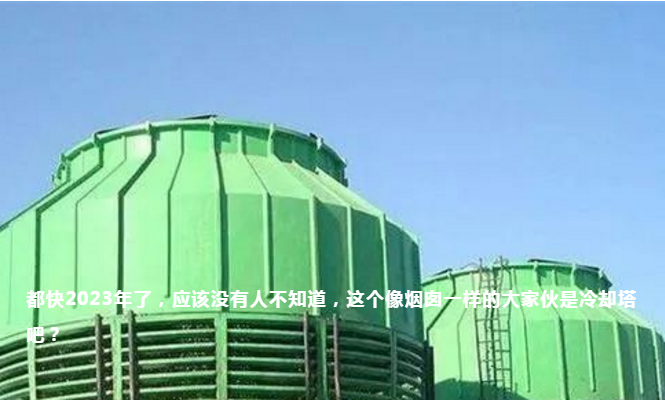
Cooling towers are widely used in air-conditioning cooling systems as well as in industrial water-cooling applications such as aluminum profile processing, steam turbines, leather tanning, power generation, injection molding, foam production, and air compressors.
As a leading enterprise in the industrial control sector, STEP masters the core technology of variable-frequency drives and has accumulated extensive experience in industry applications. For cooling towers, STEP has developed a drive solution featuring the AS170Plus variable-frequency drive paired with a permanent-magnet direct-drive motor. This solution boasts advantages such as low noise, high torque, excellent control performance, high protection rating, and easy maintenance, enabling customers to produce products with higher added value and greater competitiveness. Moreover, STEP is actively contributing to the achievement of the “dual-carbon” goals through concrete actions.
#01 Introduction to the Working Principle of Cooling Towers
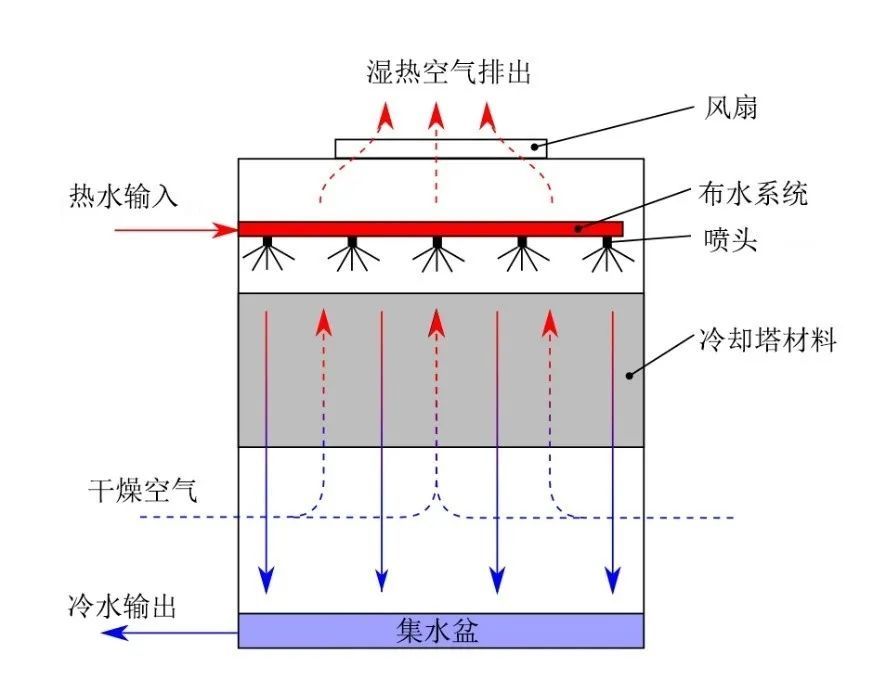
Cooling Tower Operating Principle Diagram
A cooling tower is a device used to cool water. It typically consists of a collection basin, a ventilation tower, a water distribution piping system, a fan, and a demister. A pump forces hot water into the distribution piping, where spray nozzles evenly distribute the hot water over packing materials, forming a thin water film. As the hot water comes into contact with dry air flowing in from the bottom of the ventilation tower, heat is transferred through thermal exchange, causing the water to evaporate and carry away heat into the atmosphere. Meanwhile, the cooled water drips down into the collection basin at the bottom, where it is then recirculated for continued use.
The evaporation of water into the air is not endless. As the humidity of the air increases and the air at the water-air interface reaches saturation, water molecules can no longer evaporate. At this point, the fan comes into play: it sends the humid, warm air upward to prevent backflow and continuously draws dry air from the bottom of the cooling tower, ensuring a constant airflow within the tower. Throughout this process, the fan’s role is to increase the volume of air delivered and accelerate air movement, thereby facilitating efficient heat exchange.
#02 Features of Cooling Tower Fans
√ Large moment of inertia;
√ The speed before startup may have an initial velocity;
√ PID control commonly used with temperature as the controlled variable;
√ Working for long periods in relatively humid environments;
√ High noise level, easily causing resonance;
√ Various drive methods can be adopted, including direct drive, gearboxes, and belts.
#03 Cooling Tower Fan Control Scheme
Option 1: Inverter + Asynchronous Motor + Gearbox/Belt + Fan
Option 2: Inverter + Permanent Magnet Synchronous Motor + Gearbox/Belt + Fan
Option 3: Inverter + Permanent Magnet Direct-Drive Motor + Fan
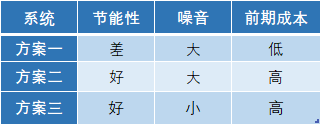
Plan One
Advantages: Low upfront investment cost and simple debugging.
Disadvantages: High power consumption, poor control performance, low system stability, high maintenance costs, and high noise levels.
Plan Two
Advantages: Compared to Scheme One, it has the following advantages.
① Energy saving;
② High torque, high efficiency, and strong overload capacity;
③ Good control performance, high control accuracy, and fast response speed;
④ The motor is smaller in size and lighter in weight, making it easier to install and maintain.
⑤ High protection rating and long service life.
Disadvantages:
The initial costs are high, and since the system drives the fan via a gearbox, it suffers from poor stability, high maintenance costs, and significant noise levels.
Option Three
Advantages: Compared to Scheme 2, this design directly drives the fan with a motor, eliminating the intermediate transmission mechanism. As a result, the structure is more stable, installation is easier, control performance is superior, precision is high, system stability is enhanced, wear is reduced, and virtually no maintenance is required in the later stages.
Disadvantages: High upfront costs.
#04 Energy Efficiency of Cooling Towers
In fan control systems, energy efficiency has become a primary concern for many customers. The following figure compares the efficiencies of asynchronous motors and permanent-magnet synchronous motors.
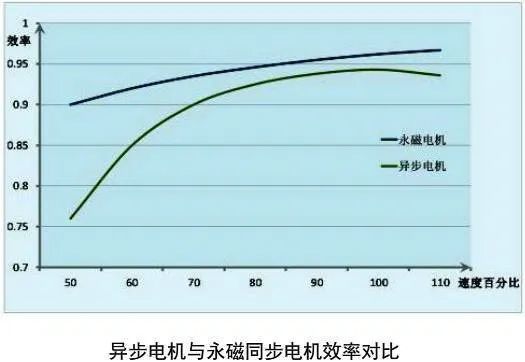
At 50% speed, the permanent-magnet motor achieves an efficiency of 90%, while the induction motor’s efficiency is only around 76%. Thus, the permanent-magnet motor’s efficiency is approximately 14% higher than that of the induction motor. At around 100% speed, the permanent-magnet motor can attain an efficiency of over 96%, whereas the induction motor’s efficiency nearly reaches its maximum value, at about 94%. The efficiency of the permanent-magnet synchronous motor is roughly 2% to 14% higher than that of the induction motor. Taking a 55-kW example: assuming the motor runs an average of 20 hours per day and operates for 330 days per year, with an electricity rate of 0.7 yuan per kilowatt-hour, then:
Energy savings: 55 kW × (2% ~ 14%) = 1.1 kW ~ 7.7 kW
Cost savings: (1.1 kW to 7.7 kW) × 20 hours × 330 days × 0.7 yuan/kWh = (5,082 to 35,574) yuan
Compared with asynchronous motors, permanent-magnet synchronous motors offer superior energy-saving performance and can significantly reduce electricity costs. The STEP frequency converters provide tailored solutions for controlling not only asynchronous motors but also permanent-magnet synchronous motors and direct-drive permanent-magnet systems. In particular, the “Shida frequency converter + direct-drive permanent-magnet” solution not only retains the excellent energy-saving benefits of permanent-magnet synchronous motors but also enhances system control accuracy, reduces noise, and lowers maintenance costs.
#05 Features of STEPeng Inverters
Multiple installation options: Depending on the specific application and operating conditions, you can choose between cabinet-mounted units or integrated units (inverter + motor).
Compatible with multiple motor types, such as asynchronous motors, permanent-magnet synchronous motors, permanent-magnet direct-drive motors, and reluctance motors.
High protection rating: The AS170Plus has an IP55 protection rating and can be integrated with a permanent magnet direct-drive motor.
Intelligent functional design:
√ Address the pain points of cooling tower fans operating in harsh environments such as cold and humid conditions;
√ Address issues such as resonance, communication failures, and shutdowns;
√ Enable the cooling tower fan system to have robust self-diagnosis and self-protection capabilities.
#06 Cooling Tower Application Case
Case 1: Inverter + Asynchronous Motor
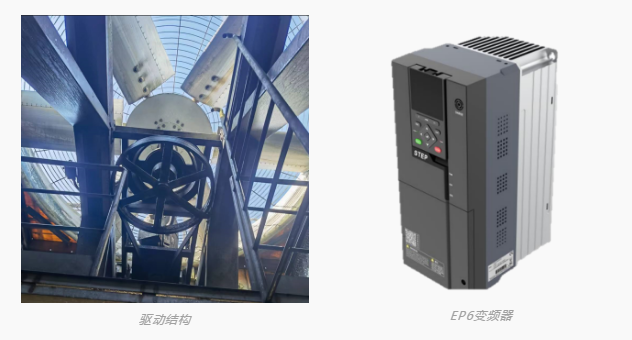
Main features:
By setting the built-in PID function of the frequency converter, closed-loop control is achieved with temperature as the controlled variable.
The motor’s switching between variable frequency and line frequency is controlled by detecting the upper and lower frequency limits.
Set rounded acceleration and deceleration curves to make the fan’s start-up and shutdown smoother.
By employing a flywheel start, when the fan is reversed by external wind forces or has an initial velocity, the flywheel start enables the fan to start smoothly and without impact.
Case 2: Variable Frequency Drive (Packed Unit) + Permanent Magnet Direct Drive
The inverter used by this application is the AS500, and it is installed inside the control cabinet.
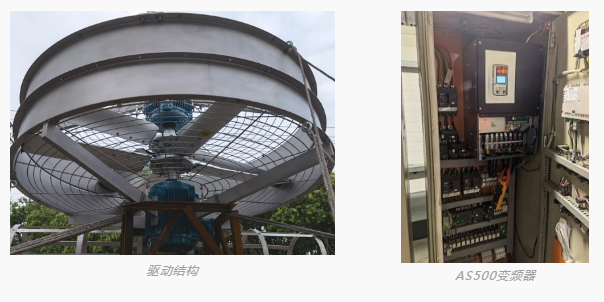
Main features:
By adopting a direct-drive permanent magnet system, this approach offers advantages over traditional drive methods that rely on gearboxes or belts, including high efficiency and energy savings, superior control accuracy, excellent control performance, and large starting torque. When used in conjunction with the AS500 variable frequency drive, it can provide customers with a smarter user experience, enhance convenience, and reduce maintenance costs.
Case 3: Variable Frequency Drive (Integrated Unit) + Permanent Magnet Direct Drive
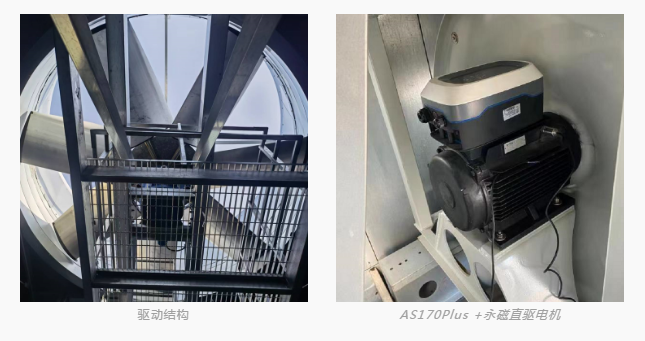
As shown in the figure, the frequency converter features a high degree of protection and can be directly mounted onto the motor. It boasts a simple structure, easy installation, high efficiency, large torque, excellent control performance, low noise, and virtually requires no maintenance.

Contact Us
Email:
market@stepelectric.com
Address:
No. 1560, Siyi Road, Jiading District, Shanghai Municipality