
Smart Inspection of Elevator Control Cabinets | Robots as “Inspectors” on STEP Production Line
2020-08-06
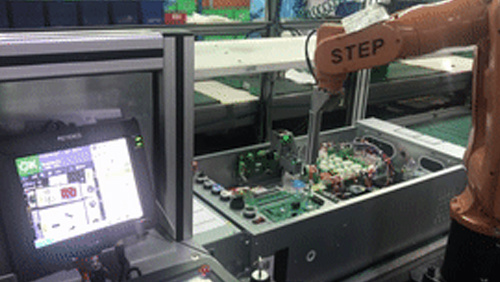
On the control cabinet assembly line in STEP Electric’s workshop, a new member has appeared—the STEP SD700E robot “inspector.”
Robot “Inspector” Takes Office
It works by scanning barcodes to retrieve order and material configurations from EMES. Utilizing visual inspection technology, it identifies contours, colors, characters, and other features, then matches them against templates stored in the visual template library. If the match fails, an "NG" (Not Good) signal is returned; if the match is successful, an "OK" signal is returned. During robotic inspection, the system communicates with EMES, storing the inspection results and images in the EMES system. Additionally, the inspection results are fully displayed on the control cabinet, providing guidance for continuous improvement in production.
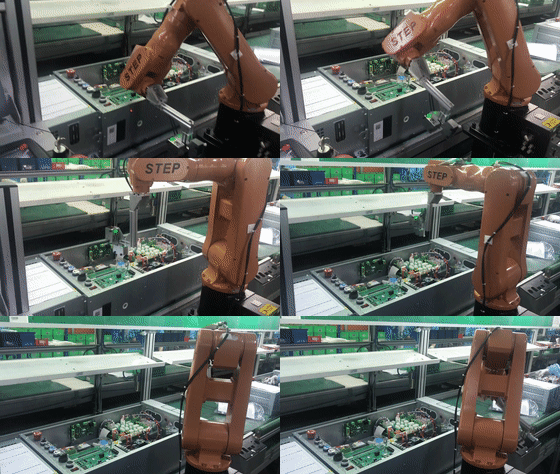
Location recognition
Currently, the visual inspection project for this control cabinet includes: identification of material models, program recognition, detection of the presence or absence and orientation of buttons, identification of the presence or absence and orientation of non-standard functions, and identification of cable sequence and color.
By using robotic “inspectors,” we can enhance the original inspection process. On one hand, this boosts inspection efficiency—reducing the time required to inspect a control cabinet from the previous 6 minutes per unit to just 1.5 minutes per unit. On the other hand, systematic comparisons eliminate the risk of errors caused by human judgment.
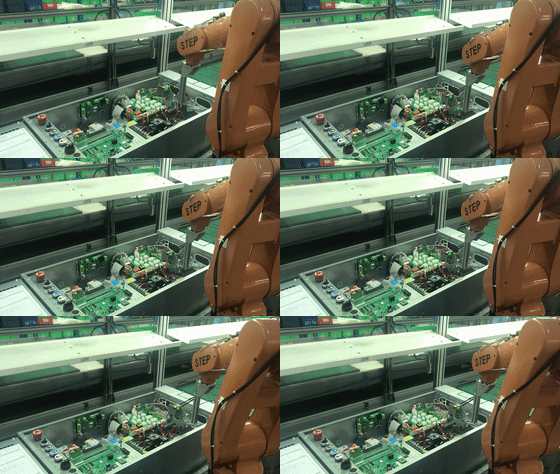
Online inspection
This project is led by the STEP Quality Team, which also provides data support. The robot team and the EMES team are jointly developing it. Based on the mixed-line control cabinet inspection station for EMES orders, this solution addresses the challenges of inspecting mixed lines with multiple product categories and non-standard materials, and is capable of testing control cabinets configured across six power ranges and more than ten different non-standard combinations.
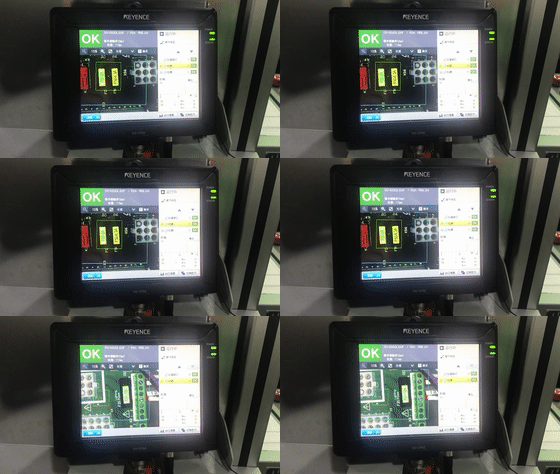
Display interface
By leveraging STEP EMES technology and elevator cloud technology, all data is stored in EMES for analyzing pass rates and frequently occurring errors, providing the necessary data support for quality improvement. At the same time, inspection results are uploaded to the inspection system, enabling shared access to these results by elevator manufacturers, thereby jointly providing technical assurance for enhancing product quality.

Contact Us
Email:
market@stepelectric.com
Address:
No. 1560, Siyi Road, Jiading District, Shanghai Municipality