
Racing against the stopwatch: The hardcore strength behind STEP breakthrough in palletizing robot technology.
2020-04-14

Recently, the high-quality robotics brand STEP announced a significant technological breakthrough: its flagship palletizing robot models SP120 and 2400 have achieved a cycle rate of 1,000 packages per hour—far surpassing the performance of other domestically produced robotic brands. The company is now poised to tackle technical challenges and aim for an international leading benchmark of 1,200 packages per hour. So, what exactly are the technological breakthroughs that have enabled STEP robots to attain such formidable capabilities? This article will reveal the secrets behind this remarkable achievement.
Let’s start by analyzing the timeline for a single cycle. The incoming materials are either single-line or multi-line streams, and one robot is responsible for handling two pallets. The robot needs to perform a 90-degree rotation during each pick-and-place operation—a scenario that closely mirrors the real-world conditions for stacking most bagged products. Under these conditions, to achieve a cycle rate of 1,000 packages per hour, each cycle must last only 3.6 seconds. Of this time, the gripper’s clamping duration is 0.3 seconds, and the time required for the gripper to open and release the package is 0.35 seconds. During this entire process, the robot has to move back and forth between the picking position and the stacking position twice, leaving just 2.95 seconds for these movements—meaning each individual movement takes only 1.475 seconds. This places extremely high demands on the robot’s operating speed. Every stage of the process must be timed down to the second if we’re to achieve this technological breakthrough.
The R&D team for drive and control systems at STEP Robot started with algorithms, optimizing the dynamics algorithm to enable robots to achieve greater acceleration and improve their dynamic response characteristics. By adopting a smooth, multi-path look-ahead algorithm, they ensured continuous and incremental velocity planning, thereby enhancing the robot’s cycle time in short-path operations. Additionally, the servo vibration suppression algorithm not only guarantees further improvements in speed and stability but also reduces the fluctuations in motor acceleration and deceleration during intermediate transition path planning, thus extending the service life of the motor and gearbox. The performance enhancements in the robot’s core algorithms and motion control represent the most critical step toward achieving higher cycle times.
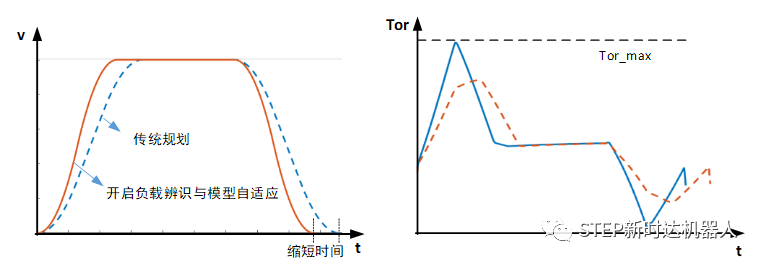
Enhance athletic performance through load recognition and model adaptation algorithms.
Meanwhile, the mechanical team replaced the motors of the SP120/2400 robot with higher-overload-capacity and more stable imported-brand motors, providing the robot with a highly efficient and reliable power system. In addition, the improved efficiency of IO signal processing ensures that the robot spends less time on communication tasks.
Robotics is an interdisciplinary field that integrates mechanical, electrical, software, and communication technologies. Tackling technical challenges requires comprehensive, collaborative efforts across all these areas. The robot has achieved a cycle time of under 3.6 seconds, enabling a high-speed throughput of 1,000 packages per hour.
Zhou Suopeng, General Manager of STEP Robot: As a high-tech industry, the core competitiveness of industrial robots lies in technological prowess. Achieving technological leadership is a prerequisite for becoming an internationally recognized brand. Following a strategic plan of "benchmarking against imports and ultimately replacing them," STEP consistently aligns its product R&D and market development efforts with those of global brands. To this end, it has established R&D centers in Shanghai, Shenzhen, Germany, and Japan, and built a highly qualified R&D team with a comprehensive disciplinary structure. The goal is to gain mastery over key robotic technologies through original, pioneering research, thereby achieving technological leadership and, in turn, securing market recognition through differentiated competition in niche segments. Robots are high-tech products, and at the heart of market competition lies technological superiority. In an era increasingly driven by quality, it is essential for robotics companies to focus steadfastly on R&D and achieve technological leadership. The robotics industry demands long-term investments in technology, talent, and capital—investments that have spanned more than half a century and ultimately given rise to today’s global industry giants. Driven by labor shortages resulting from population aging and the growing demand for personalized solutions, the robotics industry is experiencing long-term, high-growth trends. The robotics sector offers a vast and enduring track—a marathon that will take time and sustained commitment. Only by continuously investing in R&D and leveraging China’s unique engineering advantage can we ensure steady progress and build truly world-class Chinese robotics brands.
Through long-term, comprehensive testing and experimentation—covering everything from individual components to entire machines, from software to hardware, and from control systems to servo systems—the R&D and engineering teams behind this breakthrough have tackled each challenge one by one, ultimately achieving remarkable results that are truly gratifying. These technological breakthroughs will soon be incorporated into STEP entire product lineup, further enhancing the quality of STEPeng robots and enabling us to deliver even greater value to our customers. This is not only a technological breakthrough for STEPeng robots but also a significant milestone for Chinese robotics brands.

Contact Us
Email:
market@stepelectric.com
Address:
No. 1560, Siyi Road, Jiading District, Shanghai Municipality