
In-Depth Coverage | STEP Robot: Safeguarding Automotive Seat Safety
2019-12-12

Shanghai Chentai leverages New Era robots to achieve automated welding, ensuring high-intensity operation and generating substantial benefits.
It’s been more than five years since STEPeng Robotics launched its products in 2014. Over the past five-plus years, how have STEPeng Robotics’ robots performed in customers’ factories? And how have customers evaluated them? With these questions in mind, we’ve embarked on an in-depth follow-up journey to track down and interview STEPeng Robotics’ long-time users.
First stop on the tracking and visit: Shanghai Chentai Pipe Manufacturing Co., Ltd.
STEP Robot Workstation: Automotive Seat Tube Welding Workstation
STEP Robot model and quantity: SA1400, 3 units.
Robot deployment start date: May 2016
Welded workpiece: Small-diameter high-frequency welded steel pipe
Let’s first take a look at the scene—photographed by the author back in June 2016—of two brand-new STEP robotic welding workstations that had just been put into operation: Shiny robots, gleaming brightly in the well-lit welding booth, tirelessly working around impeccably clean welding fixtures.
June 2016, on-site video
After a gap of three and a half years, on November 6, 2019, in Heqing Town, Pudong, Shanghai, Mr. Wang, the production manager at Shanghai Chentai, led the author to once again visit the STEP Robot Welding Workstation, which had been running continuously for 42 months. After years of rigorous welding tests, both the robots, the tooling fixtures, and the welding booth had become thoroughly blackened with soot.
General Manager Wang explained that these two sets of workstations at STEP have been operating under a high-intensity production schedule, with two shifts running year-round. Each shift has an effective working time of about 10 hours, and each workstation produces 700 pieces per shift. Previously, each shift required at least six welders; now, only two general workers are needed. Moreover, the welding process is well-controlled, resulting in low spatter and significantly reducing the costs associated with post-weld cleaning. The welded products undergo online eddy-current testing and pass rigorous metallographic inspections of the weld seams as well as penetration-depth tests. The qualification rate exceeds that achieved by manual welding, ensuring top-notch weld quality for the high-frequency welded steel pipe frames. At Chentai, which annually produces 10 million automotive seat component parts, the stable and efficient robots from STEP have made their invaluable contribution and have become true guardians of the safety of automotive seat frames.
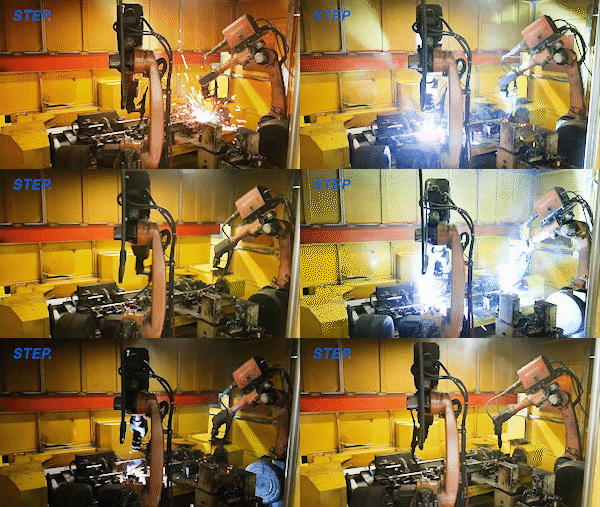
November 2019, on-site
As a seasoned manufacturing expert, Mr. Su Hai, General Manager of Shanghai Chentai, believes that STEP robots have demonstrated excellent performance in both efficiency and stability over the past three-plus years. The successful integration of these robots into Chentai’s operations is closely linked to our strong emphasis on maintenance and upkeep, as well as employee training. Moreover, it is inextricably tied to STEP product quality, the selection of welding equipment, the design and manufacturing standards of tooling and fixtures, and our capability in applying advanced welding techniques.
Mr. Su shared his insights on the practical application of robotic welding. The automotive seat frame products come in a wide variety, with small batch sizes, tight delivery deadlines, and fast production rhythms. The weld seams are complex—short, numerous, and often hidden in hard-to-reach areas. This poses high demands on the synchronization between the robot and the positioner during the welding process, placing significant challenges on robotic welding systems. STEP robots were designed with these factors in mind; therefore, after initial run-in period, they have been operating smoothly since delivery. Mr. Su also emphasized that, throughout the operation, it’s crucial to pay close attention to equipment maintenance and employee training, and to replace wear parts on schedule.
November 2019, full on-site video
Mr. Su also candidly shared his thought process behind the decision to procure robots from STEP at the time. In 2016, Chentai had 15 to 20 welders, and their monthly salaries plus overtime pay totaled over 14,000 yuan. Faced with the ongoing upward trend in welder wages, Chentai decided to give robotic welding a try. STEP, as a leading domestic brand, caught Mr. Su’s attention. After careful consideration, Mr. Su chose STEP on a trial basis. Now, looking back, STEP robots have successfully endured more than three years of intensive use, delivering stable performance and helping Chentai recoup its project investment well ahead of schedule.
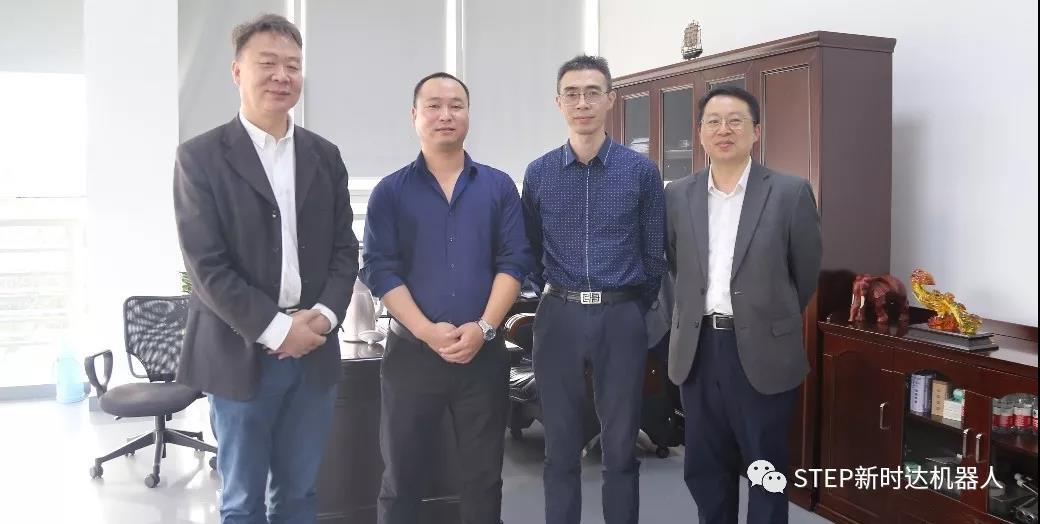
General Manager Su Hai (second from right), General Manager Wang (second from left)
Interestingly, thanks to Chen Tai’s thorough approach to environmental protection—installing arc shields and dust-collection devices in the robot welding workstations, providing workers with protective gear, and ensuring stable working conditions for车间 workers—we encountered on-site a veteran worker who has been operating at the robot workstation ever since STEP Robotics was first put into service. Seeing him diligently and efficiently working in front of the robot, as professionals in the robotics industry, we felt genuinely delighted. STEP Robotics not only frees workers from strenuous welding stations plagued by intense light and severe dust pollution, enabling them to work more happily and comfortably, but also ensures the safety of car seats—and, by extension, the safety of each and every one of us—through its superior welding quality.

Contact Us
Email:
market@stepelectric.com
Address:
No. 1560, Siyi Road, Jiading District, Shanghai Municipality