
STEP Palletizing Robot | Agile Movements, Extraordinary Power
2019-06-27

As is well known, it’s simply impossible to achieve efficient operations in a warehouse by relying solely on manual labor for the handling, placement, and retrieval of goods. In warehouses with a relatively high degree of automation, efficient and rapid goods retrieval and storage are realized through the use of AGV mobile carts and various accompanying palletizing robots. Consequently, palletizing robots have found widespread application in warehousing and logistics.
Replacing manual handling and palletizing operations with palletizing robots can rapidly boost production output and efficiency, while also reducing errors caused by human labor. A robotic palletizing system can operate 24 hours a day, significantly cutting labor costs and achieving the dual benefits of workforce reduction and increased productivity.
So, as an industry-leading STEP palletizing robot, what changes can it bring to users?
Improve work efficiency
The STEP palletizing robot can handle payloads of up to 275 kg and boasts significantly higher speed and precision than manual labor. Depending on the load, its maximum linear motion speed can reach 2,500 mm/s, and its handling capacity can amount to 1,100 cycles per hour.
Each palletizing robot has its own independent control system, with a repeat accuracy of up to ±0.2 mm, fully meeting the positioning requirements for logistics palletizing operations.
Typically, mechanical palletizers have a power rating of around 26 kW, whereas the STEP palletizing robot has a power rating of about 5 kW, significantly reducing customers’ operating costs.
Multi-network control
In terms of network control, the STEPeng palletizing robot can communicate via “point-to-point” connections, as well as through various international standard bus interfaces or Ethernet, enabling convenient, fast, and reliable exchange of signals and data with peripheral devices and host computers, thus realizing networked control on-site.
By programming software, setting and flexibly optimizing different motion paths allows for the diversified handling requirements of various product types during operations.
Improve technology, reduce costs.
The STEP palletizing robot continuously integrates the latest scientific and technological advancements. For example, by adopting 2D (two-dimensional planar) and 3D (three-dimensional stereoscopic laser) vision systems, the robot can automatically identify the positions of objects being picked up, making palletizing operations more flexible and reducing costs associated with product conveyor belt positioning equipment and labor expenses.
The STEP robot palletizing system is compatible with various types of packaged finished products, including cartons, bags, cans, beer crates, and bottled items, and can meet the requirements of industries such as chemicals, beverages, food, beer, and plastics.
The following case illustrates how STEP palletizing robots handle the picking and stacking of bagged products, boxed products, and items of various specifications in feed, synthetic fiber, and unmanned warehouse applications.
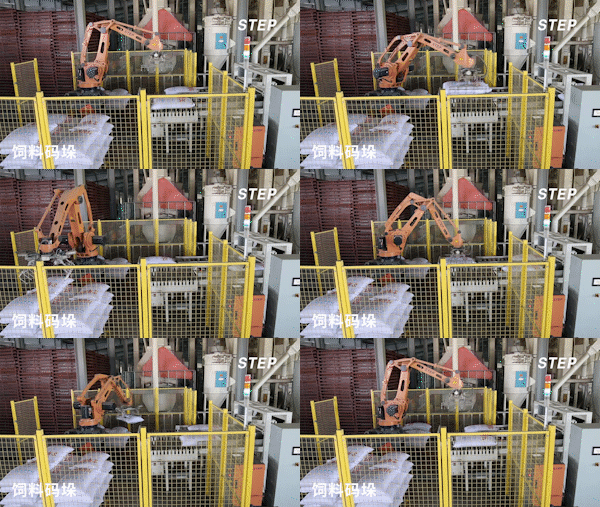 Feed bagged items | Handling and palletizing
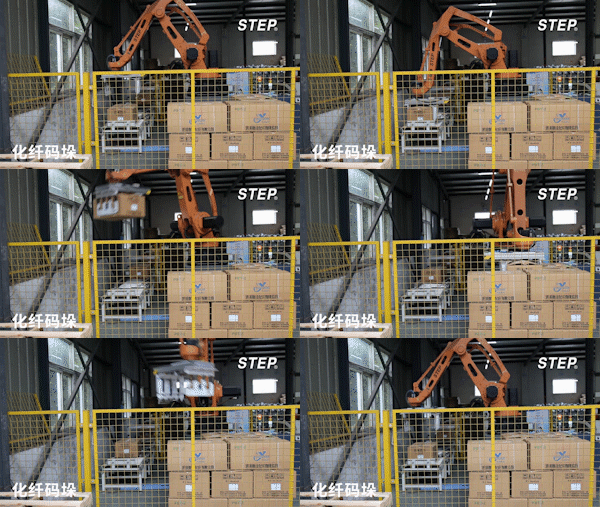 Chemical fiber boxed items | Handling and stacking
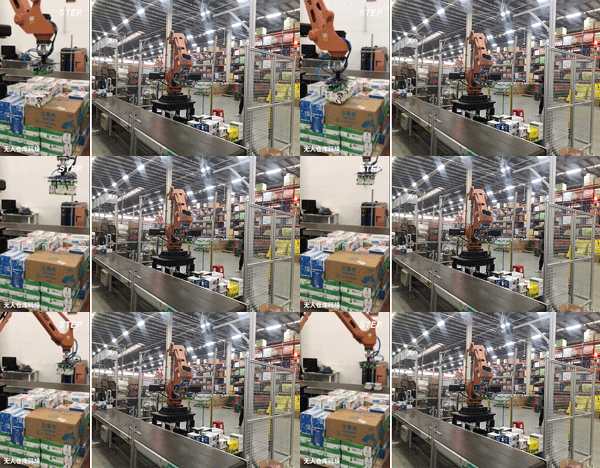 Unmanned warehouse: handling and palletizing items of various specifications

Contact Us
Email:
market@stepelectric.com
Address:
No. 1560, Siyi Road, Jiading District, Shanghai Municipality