
[Xinhua News Agency Report] STEP Helps Rapidly Boost the “Population Density” of Robots.
2022-03-09
![[Xinhua News Agency Report] STEP Helps Rapidly Boost the “Population Density” of Robots.](https://omo-oss-image.thefastimg.com/portal-saas/pg2025033114062148196/cms/image/43fdf788-2836-425e-8ccd-08ba8940a168.jpg "[Xinhua News Agency Report] STEP Helps Rapidly Boost the “Population Density” of Robots.")
[Editor’s Note]: On March 7, 2022, Xinhua News Agency published an article titled “【Urban Rhythm】Decoding the ‘Magic City’—Landlords, Robots, and ‘Carbon-Selling Elders’ Reveal Just How ‘Hardcore’ Shanghai’s Economy Is.” The article reported that Shanghai’s industrial robot density—the number of robots per 10,000 workers—has reached a nationally leading level. The article also gave high praise to the “robots manufacturing robots” production line at STEP Robot’s super factory. Additionally, the article mentioned that Haili Group had begun introducing STEP robots as early as 2015.
It’s worth noting that as a robotics R&D and manufacturing company, STEP has taken the lead in widely deploying robotic applications. Currently, the robot density within its factories has reached 1,080 units, surpassing that of Singapore—the world’s current leader—with 932 units.
Looking ahead, STEP will continue to help Shanghai and the entire country increase the “population density” of robots, freeing workers from heavy, polluting, and monotonous tasks and helping manufacturing move toward high-quality development.
Below, we’ve excerpted the key points from the original text for our readers.
Everyone knows about Shanghai’s economic dynamism and vibrancy, but here are some facts you might not be aware of: Not only does Shanghai have the highest population density in the country, its “robot population density” also far exceeds the national average.
……
There’s a lot to be discovered in these small indicators—revealing the robust pulse of Shanghai’s economy, showcasing the strength of its smart manufacturing—both hardware and software—and capturing the vibrant energy of green, low-carbon, and coordinated development. That’s precisely what makes Shanghai so tough and resilient.
Shanghai’s “population density” of robots far exceeds the national average.
Robots are hailed as “the jewel atop the crown of manufacturing.” In Shanghai, there’s not only a “superfactory” for automobiles, where hundreds of robots are busily assembling cars on the production line, but also a “superfactory” for robots—where robots are used to manufacture other robots.
At the Shanghai STEP Robotics Superfactory located in Jiading District, robots are operating with precision on the production line: assembling parts, transporting materials, inspecting products... Among the three production lines, the small-load robotic automated production line is particularly eye-catching. It comprehensively integrates multiple smart manufacturing technologies to break down processes, customize assembly and logistics lines, and develop specialized tooling—thus enabling robots to manufacture robots. Notably, the robots used on this production line also come from STEP itself.
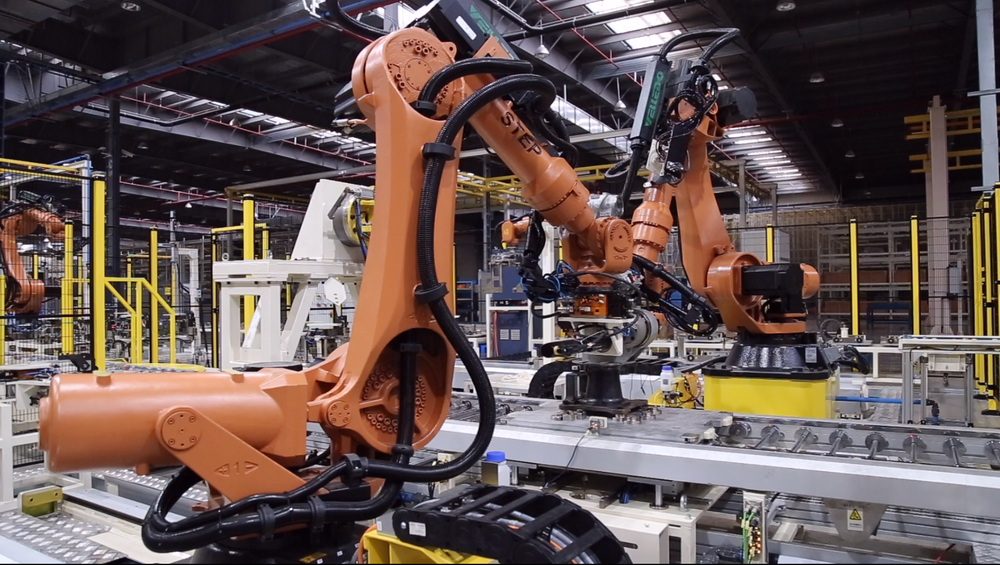
Shanghai STEP Robot Super Factory Scene
In February 2022, five smart factories in Shanghai were recognized as national-level pilot demonstration factories for intelligent manufacturing. Among them was the STEP Robot Super Factory—the first robot-manufacturing smart factory in Shanghai to be completed and put into operation. Currently, the factory has an annual production capacity of 10,000 industrial robots, which are applied across multiple industries including 3C electronics, welding, palletizing, and rubber tire manufacturing.
“Competition among robots is also fierce—beyond just having strong technical capabilities, they must also possess soft power,” said Wu Yuhui, General Manager of STEP Co., Ltd. As robotics applications expand from manufacturing into the service sector, their scope will gradually broaden. For example, STEP newly launched Amal service robot can seamlessly integrate with elevators for intelligent dispatching, providing core products and smart solutions for unmanned, intelligent building services in the public service industry.
“Robot density is an important indicator for measuring a city’s level of intelligent manufacturing,” said Han Daidong, Director of the Intelligent Manufacturing Promotion Division of the Shanghai Municipal Commission of Economy and Informatization. Shanghai ranks first in China in terms of the scale of its industrial robot industry, with robot density in key industries reaching 383 units per 10,000 workers—some enterprises even boasting densities as high as nearly 1,000 units per 10,000 workers, far exceeding the national average of 246 units per 10,000 workers.
As a major hub for robotics in China, Shanghai is striving to become the world’s first city to release a robot density index. Behind its boldness and pioneering spirit lies Shanghai’s years of deep and meticulous cultivation in the field of intelligent manufacturing—where a series of key elements—including policies, technology, talent, and funding—are interconnected and linked together, continuously sparking new vitality.
Cao Jin, Chief Engineer of Intelligent Manufacturing at Haili Group, stated that the company has built multiple intelligent manufacturing production bases around the world. However, many high-value-added and innovatively designed products are born precisely from the Shanghai Smart Factory—thanks to the city’s unparalleled advantages in high technology and specialized talent. Currently, the company’s robot density has reached 954 units per 10,000 workers.
For the development of the manufacturing sector, digital transformation is no longer a “choice”—it has become an “essential course” that determines survival and long-term growth. According to the “14th Five-Year Plan for the Development of Shanghai’s High-end Equipment Industry,” by 2025, the city’s high-end equipment industry will see its industrial output value exceed 700 billion yuan. New models of intelligent manufacturing will be further widely adopted, the degree of factory digitalization will continue to rise, and more than 40 municipal-level smart factories for high-end equipment will be built. (Originally published on March 7, 2022, by Xinhua News Agency)

Contact Us
Email:
market@stepelectric.com
Address:
No. 1560, Siyi Road, Jiading District, Shanghai Municipality