
Where lies the path forward for domestically produced arc welding robots? STEP has successfully tapped into niche markets.
2022-09-13

Welding, much like “tailoring” in industrial manufacturing, uses an electric arc to firmly join individual components that need to be assembled together. The quality of the welding process—whether it’s handled perfectly or not—plays a decisive role in determining the final product’s quality. In the past, factory welding scenes were characterized by thick smoke and dust, dazzling arcs, and flying sparks of molten metal, creating an exceptionally harsh working environment for welders. However, the advent of arc-welding robots has transformed this situation.
The six-degree-of-freedom hollow robotic arm, wielding a welding torch, can work tirelessly around the clock when paired with supporting peripheral equipment. In today’s factory production lines, humans have become mere operators who guide machines. By introducing arc-welding robots, we can ensure higher quality and greater stability in welding processes, significantly improve workers’ working conditions, further boost factory productivity, and make industrial production models more flexible...
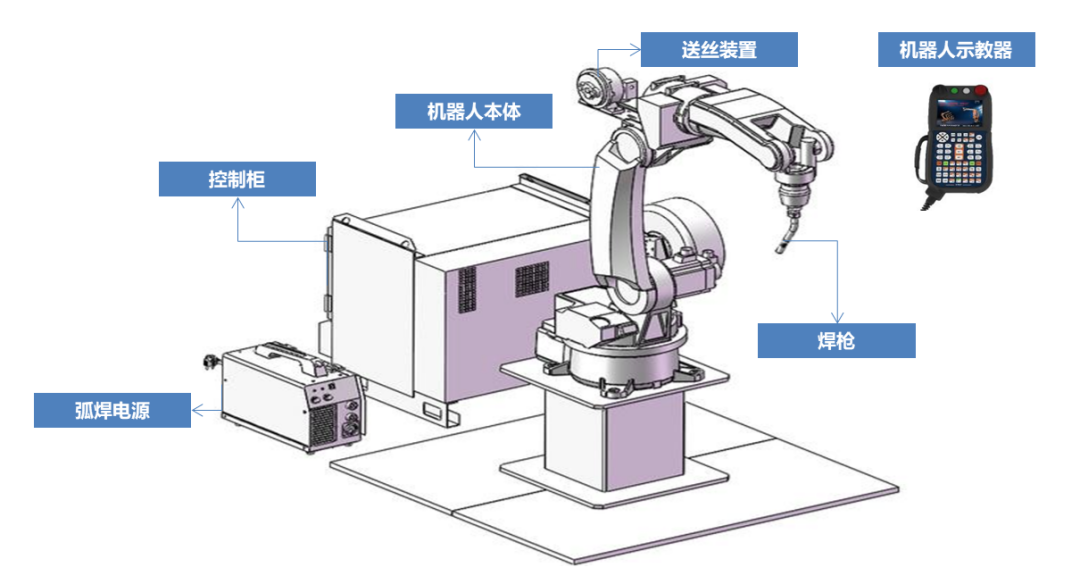
Basic Components of Arc Welding Robots
#01 Arc welding robots are the first to enter the automotive industry; demand in general industrial sectors is poised for a surge.
Since the 1990s, with China's introduction of advanced manufacturing technologies and production equipment, China's automotive manufacturing level has evolved from workshop-style production to large-scale production. Taking this opportunity, arc-welding robots from foreign brands began to enter China in large numbers, capturing most of the market. As we entered the 21st century, China accelerated its efforts in automation, placing particular emphasis on the robotics sector, and domestically branded arc-welding robots entered a period of rapid development.
Before 2017, China’s welding market experienced robust growth, driven by businesses such as metal processing in the automotive industry. Among all downstream application industries for arc-welding robots, the automotive sector accounted for over 55%, primarily used for welding components such as vehicle chassis, seats, and body structural parts. According to data from MIR DATABANK, in 2017, China’s arc-welding robot market sales exceeded 20,000 units, representing a year-on-year increase of 41.8%. However, at that time, foreign brands virtually monopolized the market, leveraging their established customer relationships with automakers and their mature technological expertise. Domestic brands, lacking self-sufficiency in core component production, faced persistently high product costs. Moreover, their overall performance and stability still required further refinement, and their service life was relatively short, making them less competitive in the broader market and resulting in more moderate growth.
In 2018-2019, the domestic automotive industry experienced a downturn, leading to a significant slowdown in the growth of the arc welding market. However, a number of domestic manufacturers emerged, leveraging their local resources to quickly respond to market demands and finding opportunities in general industrial sectors, thereby cultivating a base of customers and laying a solid foundation.
Since 2020, China’s welding market has entered a new round of rapid growth. On the one hand, industries closely tied to exports—such as hardware and furniture, two- and three-wheeled vehicles, and fitness equipment—have seen a significant surge in demand for welding equipment. In 2021, shipments of general industrial arc-welding robots accounted for half of total robot shipments. Investment in medium- and thick-plate industries—including construction machinery, building machinery, shipbuilding, and container manufacturing—has also increased, driving strong demand for welding robots. On the other hand, spurred by the pandemic, companies’ calls for automation upgrades have grown even stronger, and the shift from “replacing humans with machines” has gradually transitioned from a trend into an urgent necessity, accelerating the development of the general industrial arc-welding market. According to data from MIR DATABANK, in 2021, China’s arc-welding robot market exceeded 40,000 units in size.
2017-2025 China Overall Market Size and Forecast for Arc Welding Robots (Units)
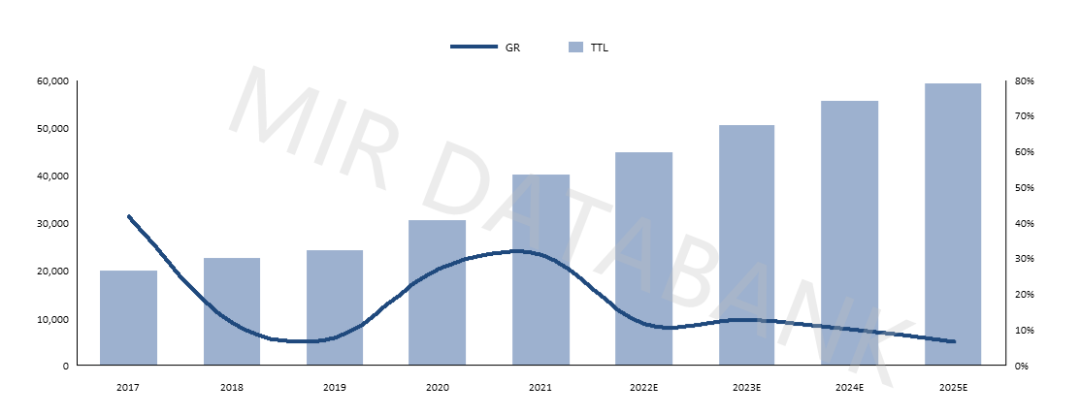
(Data source: MIR DATABANK)
As technology continues to evolve and iterate, the arc-welding robot technology of domestic brands has become increasingly mature, with costs steadily declining and prices continuously dropping, leading to rising market acceptance year after year. Coupled with supportive policies for intelligent manufacturing in China, the market is expected to maintain steady growth in the future, and competition among both domestic and foreign robot manufacturers in this field will intensify further.
#02 Foreign investment occupies a large share of the market; domestic investment has enormous growth potential.
Currently, the robots used in China mainly come from three major brands: Japanese, European, and domestic Chinese manufacturers. According to data from MIR DATABANK, in 2021, foreign-brand arc welding robots accounted for over 64% of the cumulative market share, continuing to occupy a significant portion of the market.
2021 China Arc Welding Robot Market Landscape (Taiwan)
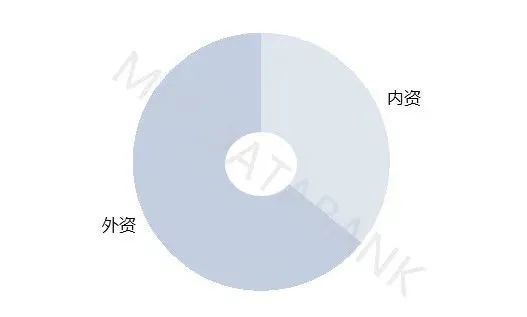
(Data source: MIR DATABANK)
Leading overseas industrial robot companies have, on the one hand, established strong cooperative partnerships with major domestic and international digital welding machine manufacturers such as Fronius, Lincoln, Megmeet, OTC, and KELDA. On the other hand, they have stepped up their efforts in developing application technologies for arc-welding robots, including laser-based positioning and 3D vision systems. They are particularly active in markets with high customer concentration, such as the automotive parts, construction machinery, container, and construction equipment industries, thereby securing a substantial market share.
In addition, some overseas manufacturers not only offer arc-welding robot bodies themselves but also produce their own-brand welding power sources, wire-feed mechanisms, and welding torches that are perfectly matched with their robots. As a result, these systems exhibit excellent stability and coordination, and are relatively easy to debug. Thanks to their superior product performance and early-mover advantage, they are widely used in the automotive parts and general industrial sectors.
Domestic manufacturers are mainly represented by STEP, and their downstream industries are primarily concentrated in metalworking markets such as two- and three-wheeled vehicles, fitness equipment, and hardware and furniture. After years of technological accumulation, the product performance of domestic arc-welding robots and their peripheral equipment manufacturers has significantly improved, while costs have also dropped substantially. As a result, these products have gained considerable market recognition in the civil industrial sector, and small- and medium-sized enterprises are increasingly adopting domestic arc-welding robots on a trial basis. Moreover, in recent years, thanks to the rapid development of new-energy vehicles, the production of components such as battery packs and motors has accelerated the adoption of arc-welding robots, further expanding the application market for these robots. With the advancement of smart manufacturing and the rapid growth of the new-energy industry, small- and medium-sized enterprises are showing greater demand for domestically branded arc-welding robots that offer high cost-performance ratios. It is expected that in the coming years, the market share of domestic brands will continue to grow steadily.
#03 Enhancing Product Features to Prepare for the High-End Market
In today’s market landscape, where foreign brands dominate the domestic arc-welding robot sector, domestic manufacturers still have considerable room for improvement. So, regarding domestically produced arc-welding robots, where exactly lies the path to future breakthroughs?
Penetrate the general industrial market Explore more niche areas.
In recent years, downstream automation investments in the general industrial market have continued to grow. In sectors such as two- and three-wheeled vehicles, medical devices, fitness equipment, cabinet and shelving systems, and hardware furniture, the penetration of domestically produced arc welding robots has begun to accelerate. Although demand in these sectors is relatively fragmented and highly sensitive to price as well as timely service, MIR Rui Industrial believes that this presents an ideal opportunity for domestic arc welding robot brands to undergo market testing and accumulate technological expertise. Going forward, domestic manufacturers should explore more niche segments, develop additional distribution channels, cultivate a larger customer base, and further refine their "powerful tools."
Among the more prominent domestic brands today, STEP has always insisted that the key to success for domestic brands lies in niche markets. ” It has already established a deep presence in industries such as power transmission towers, architectural steel structures, all-terrain vehicles, and construction machinery. Taking power transmission towers as an example, STEPeng has developed an intelligent robotic workstation for tower base welding by employing innovative parametric programming and laser-guided welding technology. With this system, users only need to input simple workpiece dimension information, and the robot can use its laser recognition system to acquire the weld seam trajectory and automatically retrieve parameters from a pre-built welding expert database, thereby enabling hands-free, intelligent welding without the need for manual teaching.
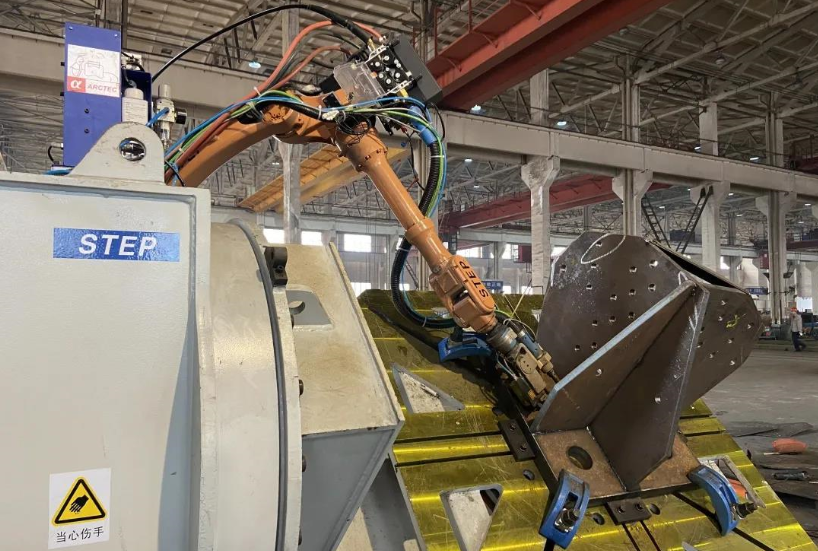
STEP tower base welding robot
Increase product investment. Multi-party cooperation with surrounding suppliers
In the fields of medium- and thick-plate applications—including construction machinery, steel structures, rail transit, and shipbuilding—there are not only stringent requirements for the precision and stability of welding robot systems provided by robot manufacturers themselves, but also demands on related peripheral technologies such as torque sensing, multi-layer multi-pass welding, laser guidance, weld seam inspection, and grinding functions integrated into welding packages. Foreign brands benefit from the backing of globally renowned manufacturers—for instance, Sairong Laser Guidance and Isra 3D Vision—giving them access to cutting-edge overall technology. Therefore, MIR Rui Industry believes that domestic manufacturers, in the future, should not only increase their investment in products and develop more process packages, but also engage in multilateral collaborations with a greater number of peripheral suppliers to break through technological barriers.
In the field of thick-plate welding, STEP is one of the domestic brands that started deploying its presence relatively early and has achieved relatively strong development. Its continuously optimized suite of welding features has already taken the lead over many domestic brands in terms of both the completeness and maturity of its capabilities for thick-plate welding, and has been thoroughly validated in numerous real-world projects. For example, the tank robot welding solution launched by STEP in the construction machinery industry leverages a variety of advanced features—including dual-robot collaborative welding, laser tracking, and coordinated use of positioners—to significantly enhance welding efficiency and quality. Moreover, its independently developed robotic control system supports collaborative welding with up to 12 axes, setting a new benchmark for domestically produced robots.
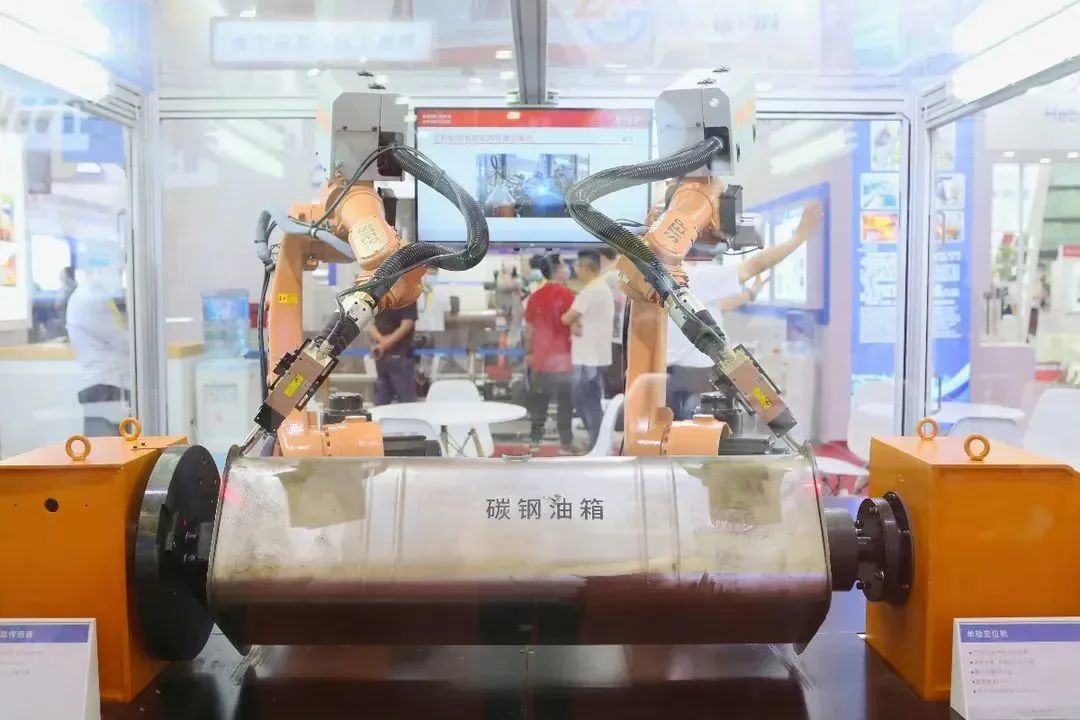
STEP Dual-Robot Collaborative Fuel Tank Welding Workstation
New-energy vehicles may become the main application for domestically produced arc welding robots. The opportunity to enter the automotive industry
In the mid-to-high-end sectors such as automobiles and automotive components—particularly in the traditional internal-combustion-engine vehicle market—the price factor carries relatively little weight when selecting equipment. Instead, automakers place greater emphasis on equipment stability, precision, and efficiency. Currently, the “Big Four” foreign-funded companies virtually monopolize this market, leaving domestic brands with significantly weaker competitiveness. Therefore, MIR Rui Industry believes that the next opportunity for domestically produced arc welding robots to enter the automotive industry lies in new-energy vehicles, especially commercial vehicles. First, the manufacturing of new-energy commercial vehicles does not demand the same level of precision as passenger cars, nor do they require the same high production capacity. This presents a key opportunity for domestic arc welding robots to break through and refine their equipment. Second, China is the primary battleground for new-energy vehicles, and domestic automakers such as Great Wall, Changan, Baojun, and Wuling are likely to provide even stronger support for domestically produced robots.
Take, for example, the SA series welding robots from STEP. Paired with a three-axis positioner and a low-splash welding system, these robots enable welds that require no secondary processing after completion, boosting efficiency by more than 1.5 times. In a closed welding workshop equipped with single-robot dual-station and dual-robot dual-station setups, the automotive seat brackets produced have been widely adopted across various models of SAIC Roewe vehicles.
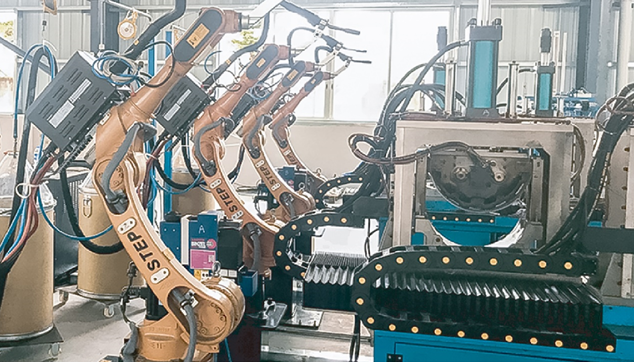
Application of the STEP SA Series Welding Robots in the Automotive Components Industry
Currently, domestically produced arc welding robots in the automotive industry are mainly used in Tier 2 and Tier 3 operational scenarios. However, with the guidance of national policies and continuous technological breakthroughs by domestic robot manufacturers, we believe that domestically produced arc welding robots will surely carve out a significant niche in the automotive industry and high-end manufacturing sectors in the future.

Contact Us
Email:
market@stepelectric.com
Address:
No. 1560, Siyi Road, Jiading District, Shanghai Municipality