
Having trouble with laser cutting? Come here...
2021-01-27

In recent years, laser cutting technology has been advancing at an unprecedented pace, growing at a rate of 15% to 20% annually. In the domestic market, laser cutting technology boasts promising development prospects and vast application potential.
STEP Operation & Control closely monitors the technical challenges in various processes of the laser cutting industry and has launched a variety of tailored solutions for the market. Thanks to their high precision, high efficiency, superior performance, and exceptional cost-effectiveness, these solutions have won the favor of numerous customers!
Panel laser cutting machine
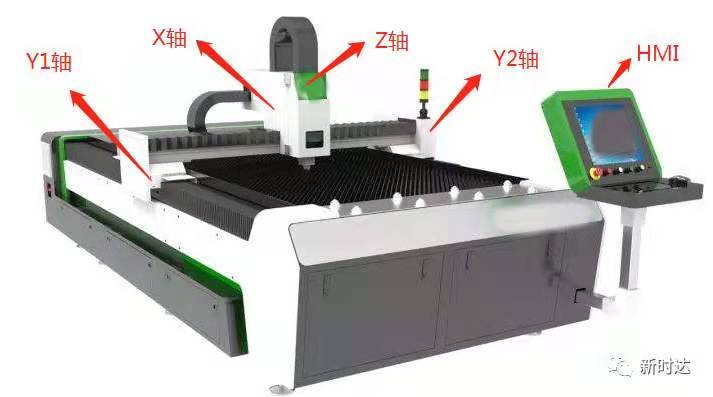
01 Equipment Introduction
The laser cutting machine consists primarily of the four axes shown in the diagram above. The X-axis controls left-right movement, while the Y1 and Y2 axes control front-back movement (in synchronization). The Z-axis—also known as the lifting axis—controls up-and-down movement. The sheet material to be cut is placed on the worktable, and the rapid response of these four axes ensures highly precise cutting results.
02 Application Solution
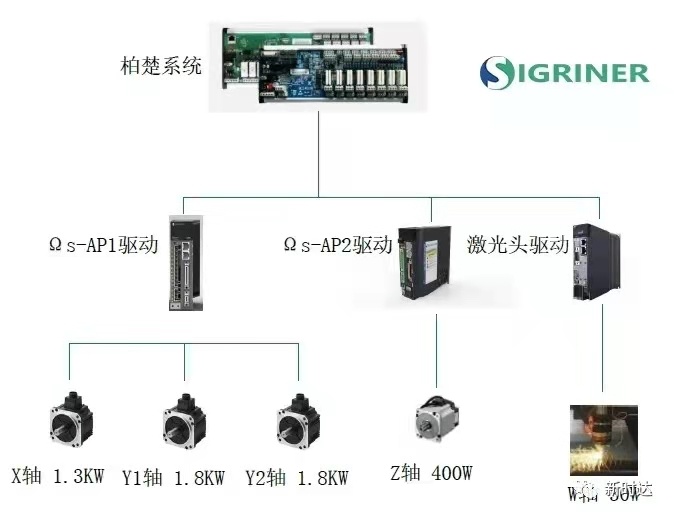
The main configuration is shown in the figure below. The laser cutting machine tool system controls five axes via pulse signals. On this equipment, the X-axis and Y1 and Y2 axes are driven by gear-rack and lead screw mechanisms. Resonance points within the system can significantly affect machining accuracy and surface smoothness. The online inertia self-recognition function of the Ωs-AP1 drive accurately calculates the actual inertia, effectively reducing debugging time and suppressing resonance points, thereby providing the most favorable guarantee for the system’s machining accuracy.
Integrated Tube-Plate Laser Cutting Machine

01 Equipment Introduction
When used as a tube-cutting machine, the integrated tube-and-plate fiber laser cutting machine employs the R-axis and C-axis to provide support for the tubes. The Y-axis adjusts the distance between the R-axis and C-axis to accommodate different types of tubular materials. Then, combined with the X-, Y-, and Z-axis movements of the laser head, the machine achieves precise tube cutting. When used as a sheet-metal cutting machine, the sheet metal is placed on the machine’s support surface, and the laser head moves in the X-, Y-, and Z-directions to perform laser cutting—operations that are entirely independent of the R-axis, C-axis, and Y-axis.
02 Application Solution
This motion program comprises a total of 7 axes, including 4 axes for laser-based mobile cutting: the X-axis, Y1-axis, Y2-axis, and Z-axis; and 3 axes for adapting to pipe cutting: the R-axis, C-axis, and Y-axis. The R- and C-axes rotate the pipe, while the Y-axis moves via a gear-rack mechanism to accommodate pipes of varying lengths.
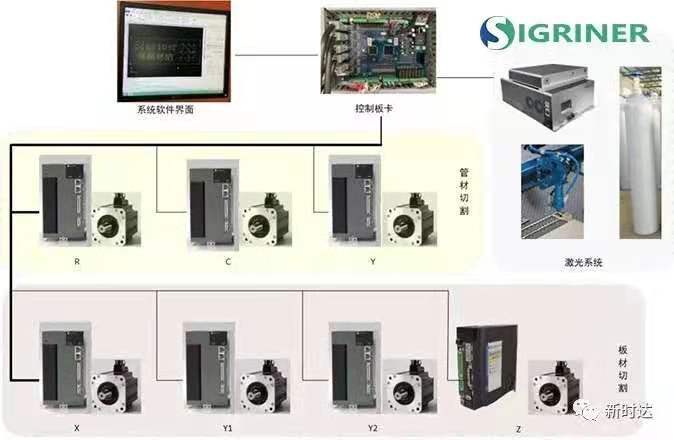
These two solutions utilize the Ωs-AP series servo drives, a pulse-type single-axis product introduced by Sigriner. The drive integrates functions such as drive control, motion control, pulse control, and I/O within its compact housing. It supports a variety of encoders, including those from Panasonic, Tamagawa, Heidenhain, Nikon, and others, making it a truly high-performance product for users of all types.
Summary
In the laser cutting machine tool industry, the most challenging issue in metalworking is the difficulty in precisely determining the moments of inertia for the three axes of the gantry structure. If the moments of inertia of these three axes cannot be accurately known, it will affect the synchronicity of the gantry structure and lead to defects in the cut circles.
As for the integrated tube-and-plate laser cutting machine, its high precision is primarily ensured by the XY-plane motion driven by the gantry structure’s Y1 and Y2 axes and the X axis; among these, the responsiveness of the gantry structure’s motion is critically important.
The Ωs-AP servo drive’s online inertia self-recognition function not only effectively identifies the precise value of inertia but also simplifies commissioning, enabling rapid achievement of precise synchronization and positioning stability in gantry structures.

Contact Us
Email:
market@stepelectric.com
Address:
No. 1560, Siyi Road, Jiading District, Shanghai Municipality