
Research and Practice on the Usability Technology of STEP Transportation Control Products
2021-01-08

The “2021 China Motion Control/Direct Drive Industry Summit Forum” was grandly held in Shenzhen on December 17, 2020. More than 500 industry professionals gathered to jointly discuss the future development of the industry.
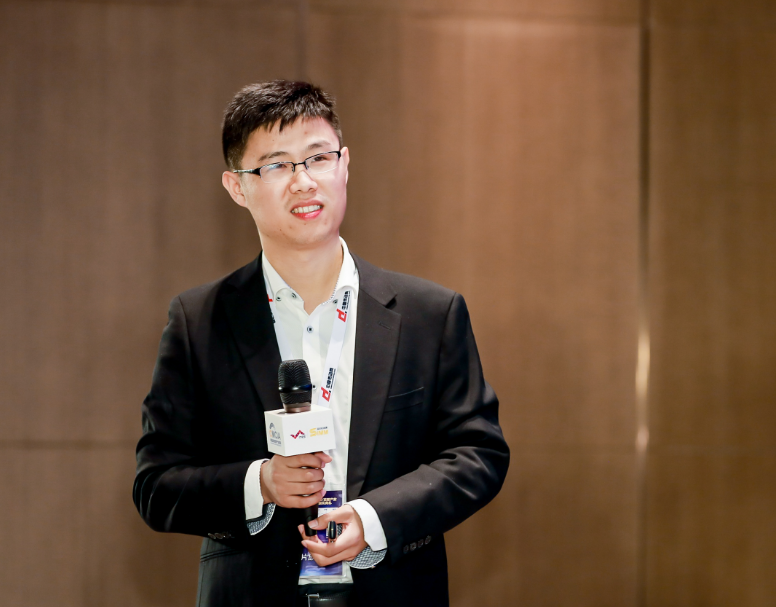
Dr. Wang Ke, Central Research Institute of STEP
In the sub-forum session on motion control technology, Dr. Wang Ke from the Central Research Institute of STEP delivered a speech titled “Research and Practice on the Usability of Motion Control Products.” In his presentation, he shared insights on motion control technology through topics such as intelligentization, digital twins, networked operations and maintenance, and ease of operation. The following content is compiled based on his speech.
Under the commercialization model for industrial products, ease of use has become a new core competitive advantage. In today’s context of smart manufacturing, however, ease of use takes on even more nuanced interpretations. For instance, intelligence—does the product require no debugging? How well does it adapt to different environments? And what about digital twins? So how can we leverage these factors to enhance ease of use? For example: programming-free robots, model simulation, visual and networked operations, as well as networked maintenance and predictive maintenance.
1. Intelligent, no debugging required
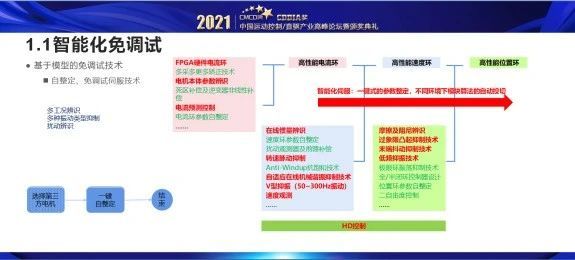
Smart and Debug-Free Technology It’s a comprehensive technology that involves all aspects of servo control, such as the current loop—and related hardware implementations like FPGA-based current loops—as well as identification of system parameters and hardware architecture, and current prediction. In the speed loop, we offer online parameter identification, rotational speed ripple suppression, adaptive online mechanical resonance suppression technology, and speed estimation. Among these, our V-shaped vibration suppression technology is uniquely ours. Friction damping identification and over-quadrant bump suppression are also advanced technologies developed by us. Additionally, our system features one-click parameter tuning and automatic switching between module algorithms depending on the operating environment, while also supporting third-party motors. Vibration is inherently complex, involving end-effector vibrations, mechanical resonances, and even intrinsic mutual interference among different vibration modes. All these technologies have been incorporated into our next-generation products.

Intelligent adaptation to complex environments. What China is doing now is replacing human labor; machine vision is the major trend of the future. Traditional machine vision can no longer adapt to a wide variety of complex environments, which is precisely where our AI algorithms come in. For example, when seasoning packets are piled together and cannot be separated, visual AI algorithms—such as the relatively mature LeNet-5 algorithm—come into play. This algorithm employs two to three levels of convolution, enabling deep learning and hierarchical feature selection, followed by fully connected layers, ultimately resulting in a trained model.

The entire process is identical to our usual training procedure, and this experiment turned out to be shorter than we had anticipated. We trained the model using 200 images and then validated it; the recognition time was less than 1 millisecond, which means that our solution can be applied in many different scenarios. In the past, we thought AI algorithms took relatively long to run—this was because we had mixed the training model with the inference model, but once we separated them, the inference phase became much faster. Moreover, in terms of usability, we’ve integrated voice control into many operations, along with human recognition and gesture recognition—all of which represent an upgrade to human-computer interaction. Voice control itself is a relatively mature algorithm; it involves some convolutional processing and time-series analysis.
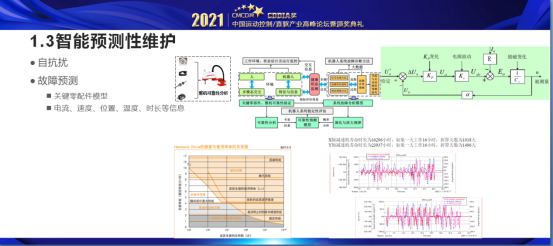
Predictive maintenance. First, we’ll develop models for some key components and spare parts. These models will be built on a deep understanding of equipment such as gear reducers and motors, and will integrate current and speed data to create predictive models. Then, by leveraging big data, we’ll provide life-span predictions.
2. Digital Twin
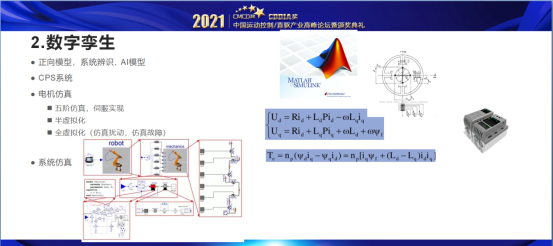
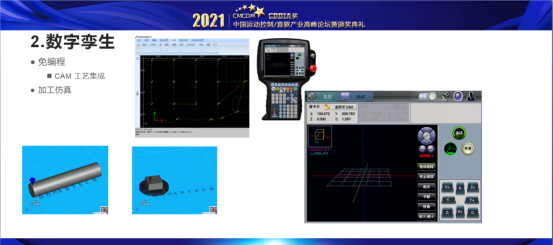
Our strength lies in our ability to implement solutions on embedded systems using a variety of approaches, whereas MATLAB struggles to run on microcontrollers. As for how to build the model—there are many different methods. One approach is called the forward model; the figure shows the typical equations for a motor, which can be used for modeling and is integrated into our company’s servo drives. On the controller side, there are also advanced servo simulations—for instance, simulating disturbances and faults.
3. Networked Operations and Maintenance
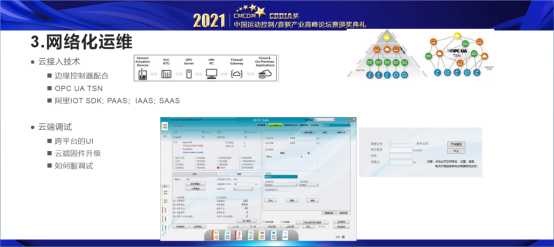
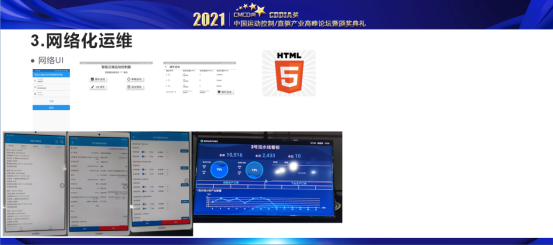
For us, the main focus is providing a range of components and figuring out how to connect them to the cloud. Currently, there’s growing advocacy for using edge controllers in conjunction with cloud solutions. So, what exactly is an edge controller? It’s not just about collecting data; rather, the “edge” emphasizes collaboration with the cloud as well as coordination with other edge-layer devices. This type of controller represents a relatively new concept, but as long as we clearly distinguish between real-time and non-real-time applications, it’s actually not that difficult to implement. On real-time networks, TSN is an important third-party standard protocol and will become a key technology of the future. At higher network layers, there are also more open protocols, such as OPC UA. And OPC UA over TSN represents a crucial technology that bridges the OT and automation realms, enabling real-time communication across these domains. We have access to a wide variety of cloud platforms—Alibaba Cloud, Tencent Cloud, Huawei Cloud—and we’ve developed a unified architecture to facilitate seamless integration with the cloud. The diagram below shows some of the software we offer—for instance, cloud-based debugging tools. There are now many cross-platform UIs available, supporting both mobile devices and PCs. We’ve also launched software for servo motor debugging, including firmware updates via the cloud.
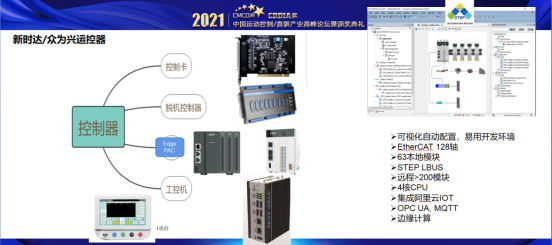
Which controllers offer these features? Here we’ve compiled controllers from STEP and Zhongweixing. Both PLCs and industrial PCs feature cloud-edge computing capabilities. At the top layer is STEP Automation Studio, which provides visual configuration tools, secondary development tools, and tools for cloud-based configuration and networking.
4. Ease of operation
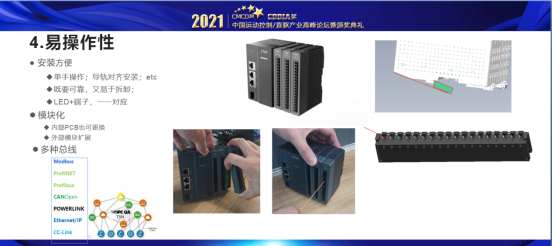
Regarding ease of operation, how can it be operated with one hand? We’ve conducted specialized experiments to ensure both safety and reliability, and we’ve addressed this by incorporating LED lights next to the terminals.
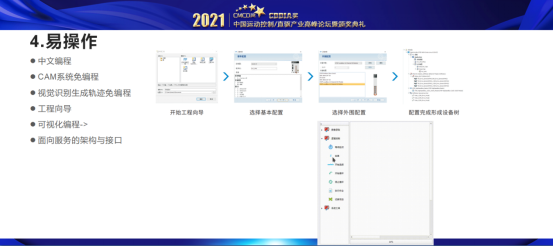
Building on the PLC platform, we offer Chinese-language programming—a highly practical and widely applicable programming approach. We also provide a CAM-based system that eliminates the need for traditional programming, as well as engineering wizards and other tools. If a customer wants to develop a specific application, they can use the engineering wizard to directly generate a robot project, a motion-control project, or a PLC project. Then, through visual programming and configuration, they can finalize their application by leveraging our service-oriented architecture and interfaces. Although service-oriented architectures and interfaces are still relatively underutilized in our industrial sector, the key challenge lies in transforming our functionalities into services. To this end, we have set up a dedicated backend maintenance system—such as our alarm system—that supports these service-oriented capabilities.
In terms of deepening our focus on industry applications, the more industrial technologies we provide tailored to user needs, the more convenient it will be for users to adopt them. We’ve developed several process packages to simplify the integration work for our users.

Contact Us
Email:
market@stepelectric.com
Address:
No. 1560, Siyi Road, Jiading District, Shanghai Municipality